Showing posts with label London. Show all posts

Saturday, 8 June 2013

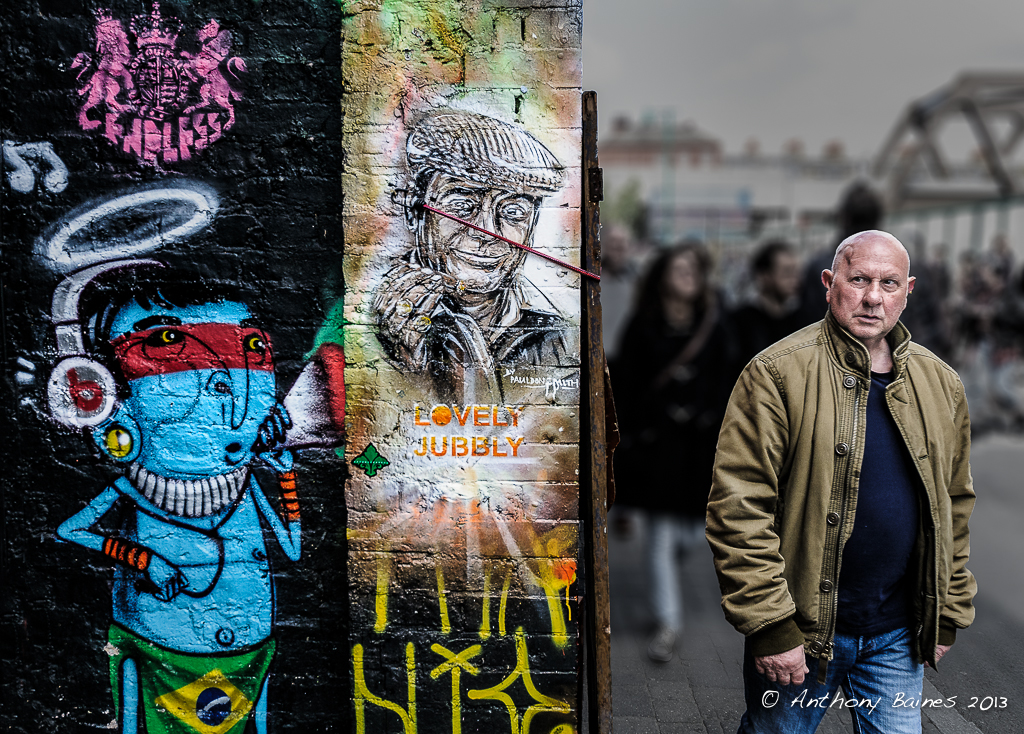
Lovely Jubbly

Lovely Jubbly

A few weeks ago, Wonky Horizons went for a day pottering in London. After viewing the Sony World Photography Awards Exhibition, we headed to Brick Lane for lunch in a Bangladeshi restaurant (extremely good, as expected). As usual, we headed off separately after that to wander some more, making pictures.

I liked some of the graffiti, as you can see in the picture above. (If 1980s UK cultural references pass you by, "Lovely Jubbly" was one of the catchphrases of "Del boy" Trotter in the BBC sitcom Only fools and horses).

Monday, 13 August 2012

Olympic London


Signs of the Olympics: Germany v Bulgaria at Earls Court
This is just a very quick piece now that the Olympics are over. As I recorded previously, along with most of the country, I had serious doubts about the Olympics before they started. But having seen the torch come through, and sampling the atmosphere around it, I felt we might have a party after all. And so it turned out. "Super Saturday" (Aug 4), when the UK’s athletes won 6 gold medals (6 times as many as in the whole of the 1996 Olympics) won me over.

I spent last Wednesday and Thursday in London trying to catch some of the spirit of the time.I've put a set of the resulting pictures on Flickr.


At St Pancras
Wednesday I was by myself: arriving at St Pancras, I walked, camera in hand, to Bond St via Tottenham Court Road and Oxford Street; then on the Central Line to Bank, and a walk along to Tower Bridge and St Katherine’s Docks, over the Bridge and to London Bridge to get the Northern Line back to St Pancras.


 The thing I was surprised about was that although the media were super-saturated with Olympics, once outside St Pancras, there was little to be seen. Some nice people were handing out free ice creams (I desisted!) and bottles of water. There were some advertising posters featuring athletes, but other than that, there was little sign that the Olympics were on at all. The copyright police had done their job more thoroughly that I could ever have imagined.

The North Bank of the Thames between Southwark Bridge and Tower Bridge was full of tourists, as expected for a summer’s day. The French Olympic mission had taken up residence at one point, with a sailing ship moored opposite. At St Katherine’s Docks, the Danes had taken over. They had a wonderful lighthearted Viking invasion by the Dickens Inn, where kids were playing with the invaders.

On the South side of the Thames, a big screen had been set up where families and office workers were watching the Games. I got there in time to see Victoria Pendleton win silver in the cycling, followed by Chris Hoy winning gold for the (I’ve lost count – sixth??) time. Huge joy and much jumping around by the assembly.

On the Thursday, Martin kindly offered me a ticket to the men’s volleyball quarter-finals at Earls Court. His wife didn’t fancy the late evening finish, so I’m most grateful to be the beneficiary. We spent the day wandering, and after an excellent lunch at a South Indian restaurant in Percy Street, came to Hyde Park. The big screens were set up there too, behind fencing on the parade ground. We had to go through airport-style security, but with better humour than you ever find at Heathrow. A restriction on photographic equipment longer than 6 inches was in force: I was amused to be asked to reverse the lens hood on my zoom to make it look shorter!


Finally to Earls Court. Poland v Russia, followed by Germany v Bulgaria. It was a home game for the Poles: the bulk of the crowd were Poland fans. We were surrounded in our seats by a wonderful, loud and highly partisan bunch of them. Their flags festooned the arena.


Russia won the game to the dismay of the people around us. Martin and I didn’t expect the disappointed Polish supporters to return after the break: they did, but only after a longish time for suitable consoling refreshment. As a result of the corresponding gaps in the crowd, we became aware of the Bulgarian supporters just along from us – just as loud and partisan as the Poles.

I’m no volleyball fan, having never even played a game, but Martin is (and has a coaching qualification). So it was great to be there with an expert to explain the finer points. I was totally caught up in the whole experience, and could not have enjoyed myself more: many, many thanks, Martin, for the ticket.

So, in all the Olympics have been a huge boost for the country's mood. It has been a real lift to the spirits in otherwise depressing times. I’m always skeptical of medals tables, since the games are about individuals, not national teams; in any case, I grew up with the Soviet Union and East Germany dominating them, which is scarcely a recommendation. Nonetheless, the fact the UK finished third is testimony to the many individual triumphs of our athletes. All our politicians now have a wonderful opportunity to keep their traps shut and not spoil the mood.

The Olympics closed last night, with a huge party in the main stadium. I probably enjoyed the closing ceremony more than the opening. The opening ceremony kept me wondering what on Earth the overseas audience (who make up the bulk of the watchers) would make of it. Wallander in a top hat with a cigar reciting The Tempest? I loved the Queen jumping out of a helicopter with James Bond – how surreal can things get? But unless you’re intimately aware of the cultural references, I can’t imagine that the opening ceremony would mean much. The closing ceremony was simple party, and none the worse for it (although the sight of Wormtail in a bowler spluttering the same lines as Wallander left me a bit bemused!). I can’t wait for Rio: where better for the party to continue?

Saturday, 21 July 2012

Olympics time


The Olympic Torch passes Canterbury Cathedral

In the next few days the 2012 Olympic Games will start in London. Media hype is in full swing, and the weather is finally relenting. As I write, there is blue sky outside, the first we’ve seen for a while.

Unfortunately, the Olympics have not yet engendered much of an optimistic mood in Britain. Partly it is the weather, partly the lousy state of the economy (with everyone, including bankers, in fear for their jobs) and partly the unprecedented censorship that has descended in the wake of the IOC. The Games are represented in the media as security theatre more than a festival of sport.

 Boris Johnson (hizzoner the Mayor of London) is doing his best: jokey, upbeat recorded announcements greet passengers on the Underground; his speeches and interviews present relentless optimism. Hitherto, however, I’ve noticed little real anticipation for the first Olympiad to be held in the UK in most people's lifetimes. 

Tower Bridge and the Rings

 I was in London for a meeting recently, and took the opportunity to pop out onto London Bridge to get a snap down the river of the Olympic rings dangling from Tower Bridge. The grey, lowering clouds above the scene seemed to sum up the pervasively miserable mood.

Rockefeller Plaza, July 4, 2005
It is all a far cry from when London was awarded the Olympics in 2005. At the time, I was working in New York, so missed out on the celebrations in the UK. In New York, though, the whole feeling was very muted: my colleagues, at least, showed no interest in Manhattan being taken over for the Games. I got the impression that New Yorkers thought it was generally a good thing the Olympics were going somewhere else. So now they’ve arrived here.

Standing in stark contrast to the broader zeitgeist, however, is the Olympic Torch. As it has made it's journey around the UK it has attracted crowds everywhere and generated real enthusiasm among most people I know.

I have very mixed feelings about the Torch, given its origins; however, bearing in mind that (a) the runners carrying it have been selected as recognition for the contribution they’ve made to their communities and (b) my next door neighbour, a silversmith, was involved in the development and fabrication of this year's model, I’m doing my best to share the enthusiasm (still doesn’t sit easily, somehow).


A day to remember

Palace Street spectators
On the afternoon the Torch came though Canterbury, the building where I work emptied as people went downtown. I joined the crowds in Palace Street an hour in advance to grab a spot of pavement, before it was entirely overrun. I chose Palace Street in order to give my pictures a sense of place: it is one of the few places on the route with a clear view of the Cathedral in the background.

Canterbury was packed – beyond anything I’d expected. I think the occupants of every office and shop must have come out. Most of all, there were foreign students everywhere: Canterbury has always hosted hordes of continental students, and they were out in force.

Wiggly worms

Selling flags in aid of Help for Heroes
While we waited for the Torch, all sorts of vendors patrolled up and down the road, selling flags, whistles, toy medals and blow up objects described with wild imagination as “Olympic Torches”.
 The whole thing was distinctly Ankh Morpork in flavour: all that was missing was Mr Dibbler and his sausages.


Torch party approaching
By the time the Torch party came up the road, it was packed; the stewards and police pretty much gave up on trying to keep everyone on the pavement – it was a bit like one of those roads on the Tour de France where all the spectators crowd in on the competitors.

Coming through


The Torch carrier, surrounded by police in grey athletic-style uniforms, hoofed through at high speed, as if trying to avoid being completely swamped. Blink and you missed it. I had time for just a couple of very quick snaps – and then it was gone.

Canterbury crowds
The crowds slowly dispersed, or, rather, melded together; the road simply disappeared under the mass of humanity. I made my way back through the hordes to the car and on to work, taking some snaps along the way.
Pictures from a window


Tourists and Morris dancers

Maybe Mr Dibbler has a new line

No Olympic rings for Canterbury 2012

Drum band outside the Marlow Theatre

Maybe we will all have a party this summer
It was clear that people really had enjoyed the occasion; there was a party mood, even if most people only saw the Torch itself for two seconds. The sun was out, and the great festival of sport is on it way. Maybe we’re going to have a good time after all.

Saturday, 21 January 2012

... And in with the (old) new

A pigeon for an audience. Nikon D700, 105mm AF DC at f2

 My four-year-old D300 has developed a major fault. It started at RIAT last year: the mirror occasionally began to stick up, especially during bursts in continuous high-speed mode. Not a big issue at the time, because it was only very intermittent.

After RIAT, I took it into Fixation who diagnosed a problem with the sequencer unit. They recommended replacing it, along with the shutter since at 110,000 shutter actuations it was getting to the point where they see those shutters failing. But adding together the price of the new sequencer and shutter units, together with a set of seals, labour and VAT made the D300 look like a car with 110,000 miles on it. So the question was – an expensive repair or a new model?

The Duxford Autumn Air Show in October saw the sequencer problem getting worse – to the point where the camera became more or less unusable in burst mode. In fact, I got sufficiently few pictures that are worthwhile from that Duxford show I've not bothered posting any on Pbase.

And over Christmas, doing some family portraits – not in burst mode – the problem get worse still. Every third exposure the mirror locked up, requiring a fairly complex reset going via live view and switching the camera off and on again.

In effect, I was without a camera. Decision time.

Nikon Rumours has been carrying increasingly detailed previews (allegedly) of the successor to the D700, the D800. Now, I have been very interested in the idea of the D700 or its successor, because I believe that the time is right to move on to a full frame sensor (more on that later). But, the D800 is forecast to be 36 megapixels and to cost the best part of £3000.

A taste for loose boots

It's quite rare for me to print larger than 18" x 12", so 36 megapixels is a complete waste on me. And for £3000 I'd rather take the family on holiday. As much as I would like more megapixels, in practise as long as I can get a pin sharp 18" x 12" print, I'm happy. The D300 gave me those just fine, so 12 megapixels does me. (Not only that, but for the projects I’m planning over the next 3-5 years, I will be presenting mounted prints at no more than 20" x 16" – so the reality is that I won't be printing most of my  important stuff at more than 15 inches on the long side, which is pretty much the exact size that a D700 image gives at 300ppi). So, the long and the short of it is that for a full frame camera, a D700 would give me sufficient pixels, 1 to 2 stops of better ISO performance than the D300 and the ability to use the majority of my lenses as they were intended for a sensor size equivalent to a 35mm negative.

Let me just amplify those last points, as they are the reasons I want to go full frame. The D300 is a wonderful camera – no doubt about it. I never got colour prints from 35mm film as good as I've got from the D300: (lack of) skill of the operator, no doubt, but for sharpness, colour and tonality I’ll take a D300 every time. Not only that but it is possible to get a decent size print from 1600 ISO. And the focusing is excellent, as is the general build quality and weatherproofing. But, like any artefact of human enterprise, it has its limitations. 1600 ISO is about as high as I normally like to go, 2500 in emergency. I've done quite a number of night shoots over the last few years: they are great fun and I am going to be doing more (next one in March). When a helicopter is hovering by hangar light (like this or this), the sensitivity of the camera is at a premium. In general terms, for this kind of shot, doubling (or better) the ISO-availability would probably double the success rate.
Liam

The other point is lenses.  In all, I have more lenses for full frame (FX) sensors than I do for crop (DX) sensors. Two of my favourite lenses are the 35mm F2 AF-D and 105 mm F2 AF DC lenses. Although these are older designs, they're small, fast and lightweight. The 105 mm, in particular, is probably the sharpest lens I own, along with the 60 mm micro-Nikkor. For many years on film these two were my go-to focal lengths, with my Olympus Zuiko 35 mm f 2.8 and 100mm f2.8 primes. I kind of "see" with these focal lengths. The D300 has a crop sensor (1.5 times factor), so the 35mm makes a nice "normal" lens, but does not give me the angle of view I tend to favour for street work. Similarly 150 mm equivalent is quite limiting for portraits, and doesn’t suit me for street work. I'll have more to say about lens choices in a  future blog piece.
Blackfriars Bridge
Anyhow, the point of this rambling is that I made a decision that I wanted to go for a D700 at this point rather than spend the money repairing the D300. (When I can afford it, fixing the D300 is also on the list).

So, I found a used D700 advertised at a reputable London dealer at a good price. It had being used fairly heavily but had a new shutter and new seals, so should keep going a good long time. Not only that, but the asking price was less than used D700's in recent eBay auctions. So, I succumbed to temptation and bought the thing.

I took the D700 for a walk along the Embankment in London, to try to get a feel for how it works. In the end, I walked all the way from Lambeth Bridge along the South Bank to London Bridge and the Borough Market. It is always pleasurable to walk along there, as we have noted on this blog before, but especially with some new gear in hand.

January sun
I just pottered along taking touristy photographs (well, actually mostly photographs of the tourists). To my surprise and delight, the 105 mm was wonderful walk around lens. In fact, I was so enjoying this lens that I left the 35mm mostly unused until I got into the Borough Market, where the confined spaces made it my preference.

Taking a break, Borough Market, D700 and 35mm f2 AF-D
Opening up the files at home, they were lovely. Very sharp, and extraordinarily smooth. Everything, in fact, the D700 is supposed to be. Most of the reviews put the D700 at 1 to 2 stops more sensitive than the D300. I reckon it is the least two stops better in practical terms. Just looking at the ISO 6400 images, I would not hesitate to use that sensitivity on a night shoot to try to capture a wobbly hovering helicopter. Not only that, but there's loads of highlight detail to be recovered. As part of trying it out, I was deliberately exposing some images to push the highlights as far as I could. There are some images where brightly illuminated buildings across the other side of the river looked like they were completely blown on the camera's screen, but in Lightroom or Capture NX 2 there's a surprising amount of highlight detail to be recovered. Again, this is very much in line with the reviews, and completely lives up to my expectations.

Perhaps the biggest downside of the D700 is the fact that the 12 megapixels being spread over a larger area do not give the effective magnification multiplier that the crop sensor does with telephoto work. It would be very nice to have the D300 back in action for the start of the next airshow season. But I can't help feeling that they are additional possibilities in other ways that are opened up by the D700 will keep me more than happy.