Showing posts with label Kent. Show all posts

Wednesday, 11 February 2015

Two variations from Rochester


The Seven Dials Rapscallions were present in force at the Rochester Dickens Festival in December 2014.They are wonderful character actors, who really convey a sense of Victorians living on the ragged and bloody edge. Phil and I were lucky enough to get some of them to pose for us.

The problem, as always at a street festival, is to put the characters in a context that tells the story in an effective way. The pictures here were taken in the middle of Rochester High Street. As you can see in the originals, below, the modern context is anachronistic, jarring and distracting. So when I shot this, I had the idea in mind of making composites of the characters against a suitable simple background. Phil is, of course, the compositing maestro, but it really isn't something I particularly do. However, this was a good stimulus to give it a try.

Leaving the festival, we stopped along the way back to the car to photograph various walls and side streets that we could subsequently use as backgrounds in compositing -- and got a lot of funny looks in the process :-). Photographing the background on the same day means that the lighting was rather similar; I used the same lens as I had for the characters, so the perspective should look similar both for both character and background. In this case, I used the 24 mm f/2.8 AF-D lens that Phil had kindly lent me for the day. The 24 mm lens is not a classic portrait lens: used close in, it distorts and gives an exaggerated perspective to the subject. But the great thing is it lends an air of unreality to the image that contributes to atmosphere.

Both these pictures were made just by placing the character (cut out of the original image) on the background, and making separate monochrome conversions in Silver Efex for foreground and background. I tweaked local contrast on the character primarily to grunge up the skin texture, and tried to increase the sinister feeling by selective darkening around the edges of the background. Simple, but quite effective, I think.

The backgrounds were easy -- the walls and streets just needed straightening and cropping to shape. The characters -- well, cutting characters out is more difficult for me. Not being a regular compositor, cutting characters out of the background is the least of my skills; there is an added difficulty in that the plane of focus was very narrow on the characters eyes, meaning that some of their clothing was actually slightly soft. However, Topaz Remask made short work of cutting the characters out. I followed the method shown in one of their tutorials, and it worked like a charm.

My thanks to the two actors featured here, as well as my apologies. They don't look nearly as sinister in real life!


Thursday, 11 December 2014

Rochester Dickens Festival 2014

One of the Rapscallions

Last Saturday (7 Dec 2014), Phil and I went back to Rochester for the Rochester Dickensian Christmas Festival. It really doesn't seem a year since I last wrote about this – you can see last year's account here. The big difference was that the weather was more difficult: windy and rainy for much of it, in the light was variable to murky. Nevertheless, I had a great time photographing the characters.

The people who dress up for this festival are truly wonderful: they're always willing to chat, and they put enormous effort into their costumes. The Seven Dials Rapscallions had an area cordoned off, as last time, where they set up camp. They were wonderfully co-operative for pictures; I also got some photos of some of the individuals out on the street later on. I didn't have much of a chance to talk to the steam punks this year, although, as before, they were out in force. Nevertheless, Phil and I did chat to one of their members who gives every impression of being the older brother of one of our street photographer friends, who also happens to use an Olympus camera.

As well as the characters the Fabulous Fezheads were playing. I've added a couple of wide-angle shots of them at the end of this post. I'd not heard them play before, and they were absolutely brilliant. They describe themselves as “England's Premier Sand Dance Illusionists”: imagine the Nutty Boys crossed with a 1920s music hall act crossed with Morris dancers and you would not even be close to what they are ;-)

This time, in addition to getting portraits of the characters isolated using the 105 mm f/2 DC lens, I wanted to get in close to some of them with wide angles. Some of the pictures you'll see below were taken with either my 35mm lens or Phil's 24 mm f/2.8 AF-D. The idea was to get some pictures with an exaggerated perspective so as to give an almost cartoonish effect. I think that many of Dickens own characters are so intensely portrayed in his writing that an exaggerated perspective is the direct way of portraying them. The pictures were all taken on my D700, using auto ISO with aperture priority. Simply processed through Lightroom as normal.

A sing along with the crowd before the parade
Fagin leads the parade

Mr Mayor, I presume


The Fabulous Fezheads, Victorian characters and mobile phone photography - all at once!


Tuesday, 14 October 2014

Nikon D810 – some follow-up thoughts

Juvenile marsh harriers at Elmley: deep crops from the D810/200-400 VRII. See text below. Click on the image to see it at full size.
Just a quick follow up to my previous post on the Nikon D810. I said that the look of the prints would be an important deciding factor. So, I got some 18” x 12” prints made (by Proam, who I think are excellent). Alongside the D810 images, I got some “control” D700 prints made from pictures of similar aircraft taken earlier this year.

The first print out of the pack was the Vulcan shot. It was one of those “Wow!” moments – it looks terrific. And the rest of the D810 shots looked terrific. Then I came to the D700 shots … err … they looked terrific as well. Actually, the differences in quality at that size print are pretty small. I showed them to Phil and asked him to guess which came from the 12MP camera, and which from the 36 MP camera. After a bit of humming and hahing, he got it right, and without any prompting from me.

So, yes, there are discernable differences between D700 and D810 pictures as 18” x 12” prints, but they are very slight. A bit more edge acutance, perhaps, but not much. Better tonality on a dull day, I think. Maybe if I got some bigger prints done, it would be clearer, but for normal pictures, normally framed and not excessively cropped, it is not a big deal.

In any case, that Vulcan picture was taken in portrait orientation as the aircraft banked rapidly: it is cropped on the left and right hand sides, and represents a crop from a full print equivalent to about 27” x 18”. The concept of making a print that size, pin sharp with wonderful tonality is stunning.

On the Sunday I had the camera, I headed off to Elmley Marshes NNR. Not a great time of the year – very much in between seasons. However, Elmley is such a magical place, there’s usually something worth seeing. Trundling in the car slowly along the track, I saw a small shape in the far distance on the ground. I pulled over on to the side of the track; a quick peek though binoculars confirmed it was a raptor, as best I could tell it was a marsh harrier. Before I could get the camera set up, pointing out of the car window, a second bird flew in the direction of the first – another harrier. Here is the full frame of the first shot (at 400mm, 1.2 crop).
Juvenile marsh harrier at Elmley: full frame
Of course, this is just a quick grab – not the right lens, fieldcraft or anything. However….

The new arrival made a beeline for the one on the ground, and they started to play. I grabbed a series of shots, just letting the camera go at 7fps for as long as they kept at it. Fairly quickly, one flew off and I lost sight of the other. I followed the one that flew off with the camera: it kept the focus – never wandered – and kept shooting, without the buffer filling up.

They are too far away for exhibition purposes, but at smallish size, suitable crops look great.  The opening image is a compilation from that series of shots.

What was really impressive was the focusing. To lock on to a small moving subject that far away, and never lose it is simply amazing. This is with the group AF, and AF-C setting. The long and short of it is that I could never have got that series on the D700. The focusing would not have been good enough, and the resolution would have been inadequate. A big win for the D810.

Since then, I’ve been to a couple more airshows – the Duxford September show and Shuttleworth Season Finale at Old Warden. I just used the D700 as usual, and I got a bunch of pictures that I really like. Both airshows featured unique opportunities for aviation pictures: the Canadian Lancaster at Dux; two (yes, two) Mew Gulls and the DH88 at OW. The D700 was great to take along because I’m now very familiar with what it can predictably do in my hands. I got some pictures that I’m delighted with. But it hunted for focus once in a while, and I lost most of one series of pictures because the focusing wandered off an aircraft as it accelerated to take off, focusing on the background instead. A low rate of loss, for sure, but I didn’t experience that at all with the D810.

So, for my purposes – and your mileage will definitely vary on this – I think the D810 is the best general purpose camera available.

Is it worth £2400 (roughly the price at present) to me? And what about the D750? Hmm ….

I’ve not shot with the D750, so can’t comment specifically. Before I’d known about the D810, I’d probably have said it was the camera for me. 24MP, 6.5 fps, top of the range AF, tilt screen (excellent for those low down pictures), great low light performance (both the latter being just the job for aircraft nightshoots), about £650 less expensive at the moment: what’s not to like?

Well … Glenn Bloore, an excellent aviation photographer, states the buffer is very small. If he says so, I believe him. Ever since I sat next to Kojak by Derwent Dam as the BBMF Lanc flew over, and he missed the absolute key shot because the buffer was too small, I’ve promised myself I’d never get a camera with a small buffer. I like the idea of the 1.2 crop as well: it turned out so well at Shoreham getting 25 MP on 240-480 mm equivalent. And 36 MP when you need it.

So, if it ever comes to it, the D750/D810 dilemma is quite acute. It is theoretical for the moment, in any case; the piggy bank needs a lot of fattening ;-) .

The trouble with male GAS is that it is never truly rational. I got my LRPS, ARPS and CPAGB with D300 pictures. The D700 is better than the D300.  If I could not get to the next stage of my (extremely slow and intermittent) letter hunt with my current gear, it is not the gear. I don’t doubt that spending £2400 on a trip somewhere exciting would see me closer to the next set of letters. But GAS is like a determined guard dog: once you’re bitten, you stay bitten.

Sunday, 9 February 2014

The Wettest Winter


This entry is just to record that we are having the most appallingly weather this winter. Us Brits (especially me) like to spend our winters complaining about how the weather is miserable, but this year really is something else. The people of the south west of England have been the worst affected by floods and storms: villages in the Somerset levels have been completely cut off by floods that cover thousands of acres; many people have been flooded out of their homes. The main rail line to Cornwall has been severed at Dawlish. The floods have spread widely over the whole of southern England.

Here in East Kent, we’ve been less badly affected, but the Elham valley, and in particular the villages of Bridge and Patrixbourne have been dreadfully affected with flood water simply rising up through the ground.

I have a regular walk that passes though some playing fields. We're nowhere near the worst affected areas, but even so, the two pictures above (taken on my phone) illustrate the flooding of a local football pitch. Nothing in comparison to the experience of many (and you can see that the nearby houses are perfectly safe), but I don’t remember this kind of flooding of these pitches before.

Addendum:

One more from this afternoon. This was the view over the valley of the Great Stour near Chilham. The Great Stour belies its name, and it is little more than a stream at this point. But the fields are now entirely flooded. Some flooding happens every year, but this really is more than I can remember.
Wednesday, 11 December 2013

Rochester Dickens Festival December 2013

A character in the parade for the Dickens Festival
Last Saturday, 7 December, I went with Phil plus our friend Katrina and her son Oliver to the Rochester Dickens Festival. I had not been to one of these before, and it's quite a long time since I've been to Rochester in any case.

Rochester is closely associated with Charles Dickens: his house at Gad's Hill Place is near Rochester, and several buildings in Rochester and its vicinity appear in his books (perhaps most famously, the churchyard of St James, Cooling, is supposed to have inspired the setting for Pip encountering Magwitch at the beginning of Great Expectations).

The heritage business is huge in the UK at the moment – the Medway/Thames estuary area is Dickens country, just as the area around Haworth is Bronte country. So it's inevitable that there should be a Dickens Festival. I don't know what it is, but there seems to be a communicable urge doing the rounds in the UK at the moment that makes people dress up in period costumes as living history re-enactors. I went up to Biggin Hill a couple of weeks ago for an evening photoshoot at the Heritage Hangar, and, naturally, there were re-enactors posing with the Spitfires and Hurricanes. You almost cannot avoid re-enactors at any organized event, but, it really can add to the fun and atmosphere.

A solid crowd packed Rochester High Street to follow the parade
 What I had not expected was the crowds! We got to the bottom of the High Street just before the parade was due to set off, and started taking some pictures of the characters. But it quickly became impossible to move around very freely with the density of both costumed characters and spectators, and once the parade started it was just a question of going with the flow and following along at a very slow walking pace.


Never having been to such an event before, I wasn't quite sure what to take in the way of gear. I was hoping to get some good street shots with quirky characters in interesting framings or juxtapositions. So, I took a 35mm prime lens along with the D700, with the intention that that would be my main lens for the day. I thought I might be able to take the occasional opportunity to get close-up portrait of one or two people, so I also took a 105 mm lens with this in mind. However, the density of people was such that it pretty rapidly became impossible to frame individuals or even groups in a way that fitted with my original idea. The 105 became my lens for the day after about the first 5 minutes, with the aim of just picking out individuals and suppressing the busyness of the background.


Anyhow, the four of us had a very entertaining day, and I got some pictures that I like. I had not expected just what a target-rich environment it turned out to be. The costumed characters were so happy to be photographed, and so cooperative it was a real pleasure. It was great fun that there were some anachronisms as well: I don't think Sherlock Holmes ever appears in a Dickens novel - much less with a camera :-) -  and I can’t quite work out what the Confederate general was doing in Victorian Britain either. The wonderful steam punks from Great Kentspectations  were out in force, although, somehow, I'm still not sure how they fit into the Dickens universe**.

After the parade, we were wondering where to go for lunch, and found a bunch of stalls out by the castle. Because there were so many people in Rochester, the cafes and restaurants were simply overflowing and, although dying for a coffee, we couldn't find anywhere with free space. However, the stalls by the castle were not completely overwhelmed, so we stopped by them for lunch.

The Taste of Thailand stall was there: they set up on our campus several times a week as well, so I am very familiar with their delicious green curries and Pad Thai; Phil, Katrina and myself chose Pad Thai, which had a suitably re-vivifying effect.

During the afternoon, it was a case of pottering around catching the occasional costumed character and generally soaking up the atmosphere. One of the things I loved was a French band of buskers called "Sur les Docks" - very energetic players and excellent musicians.

First time at a such a crowded festival – what did I learn photographically? Taking a fast portrait lens was really helpful – shooting wide open, or nearly-wide open, meant I could isolate characters against the background, even when it was really busy. I think I also need to be much more active at getting in and photographing them: if Phil or Katrina got to a character before I did, I tended to leave them to it. There was a wonderful Miss Havisham, for instance, with spiders in her veil: but because Phil and Katrina spent some time photographing her, I didn't want to bother her myself. Next time I shall! Something that was extremely helpful was shooting the D700 in ISO-unlimited fashion (this is Britain in December, after all, where the light rarely gets better than murky). I set the camera on manual with auto-ISO and a shutter speed of 1/250, and just changed aperture for what the picture needed. The liberating thing about the D700 is that you can simply forget about the ISO for the most part and just choose shutter speed and aperture according to what the picture needs. (Then again, the size of the D700-105 combination, its weight and the loud clunk of its shutter are not so liberating….)

Anyhow, I'm looking forward to going back another time. If you've not been, as long as you do not have a fear of being tightly hemmed in in a vast crowd, it is a great day out.

**UPDATE 13 December 2013. Victoria Sparks from Great Kentspectations got back to me after reading my comment above that I didn't see where the Steampunks fit into the Dickens universe. Here is what she said. "We see steampunk as a branch from the Dickensian/ Victorian culture, most of our characters and looks are based on Victorian Science fiction (H G Wells, Jules Verne) and also alternative Victorian history (who's to say some of Dickens unfinished pieces didn't include characters like us :P ). Our main goal is to have fun and bring something different to big events like this, it is our 4th time at the Dickens festival and our popularity is growing within the public and the re-enactors groups too, some gave us the name "the new Victorians" which we thought was lovely." Thanks so much, Victoria - much appreciated, and I'm looking forward to meeting you again the future.

Tuesday, 9 October 2012

Panning for abstracts

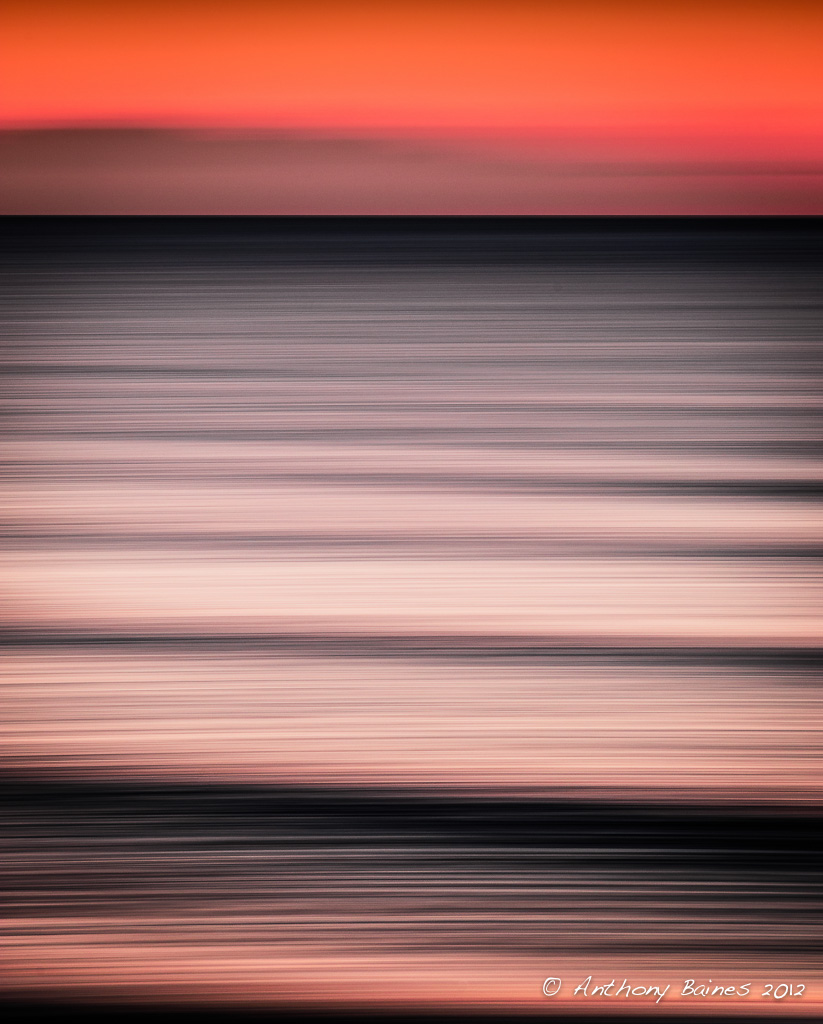
Dawn over the English Channel, in abstract


One of the things that I enjoy is to try to simplify the subject to the point where its essence can be abstracted. It's possible to create an impression of the subject that almost discards the original and yet leaves the intrinsic rhythms intact.

One approach is to pan the camera with a slow shutter speed across a static subject. This removes details, and yet, done correctly, leaves behind the rhythmic elements that can define the subject's intrinsic nature.

Many years ago, in film days, I used occasionally to try panning the camera on static subjects to get this impressionistic view. It never really worked for me. I now realise that the constraints that we all felt with the expense of film (especially colour slides) meant that I never worked at it hard enough.

Yet another of the benefits of digital is the ability to take a lot of pictures and really work at a subject at essentially no cost. Reviewing and refining the method of panning while working on a picture helps enormously, and this can really only be done with digital.

Over the past few years, I have occasionally tried this again; here are a couple from this year that I quite like. Both of these required a reasonable amount of work to generate a selection of images that represented what I was after, and from which I was able to choose one that I like best of all.

Waves approaching a shore have a natural rhythm and periodicity that can be brought out by removing all the general splashing of the sea by panning camera horizontally. Trees whose energy is directed upwards can be an abstracted from the forest using a vertical pan.

It should be possible to do something like this in Photoshop (by applying a motion blur for instance), but I've never felt that approach is terribly satisfactory. By working on the subject with the camera and trying variations of technique, speed, direction is possible to obtain very pleasing abstraction of subjects without any postprocessing.

The way I go about this is to choose a shutter speed that is sufficiently long to allow blurring while I pan the camera fairly rapidly across the subject, keeping the movement as smooth as possible. The nature of the subject will dictate the shutter speed but typically between 1/4 and 1/30 second, using a relatively normal focal length (any focal length suitable to the subject, but usually with a standard zoom). Normally this can be done with setting the camera to its lowest ISO with shutter speed priority. On very bright days it may be necessary to add a neutral density filter, especially if you want to retain some control of depth of field.

Typically I pan the camera over the subject and just take one picture that includes the area of interest. I'll repeat the panning several times, because each attempt yields a different result. Then I review the pictures on the back of the camera and make adjustments to shutter speed, exposure compensation etc. I might end up with 50 tries for a single image.

The one at the top of page comes from Dungeness a few days ago. Phil, Martin and I arrived on the beach before dawn, and this was a picture I had previsualised. The picture was taken almost immediately before sunrise.

The last picture comes from some bluebell woods near us last spring. I have tried the panning technique each year for the last three or four, and generally get something that I rather like. This one is a bit of a favourite.

Many other photographers have tried this, and it's worth looking at their work for inspiration. As an example, Julieanne Kost has done slow exposures from a car window, so that the motion of the vehicle represents panning across the subject. I've tried several times myself with limited success -- but that won't stop me trying again.

Impressions of a bluebell wood, #3.

Sunday, 30 September 2012

Shooting a band: Fat Tuesday

Fat Tuesday: from left Michela (accordion, vocals), Bill (guitar, mandolin, vocals), Steve (drums) Graham (fiddle), Roy (Guitar). Photo by Anthony.

 My colleagues at work Bill and Steve have a new band. They are called Fat Tuesday, named after the direct translation of Mardi Gras. As you can imagine with a name like that, they play Cajun and zydeco with a bit of rock 'n' roll and folk too. You can hear samples on their music on their MySpace.

They are shortly to start recording a CD, and needed some pictures for the cover, and also for general publicity. So Bill asked me if I would be willing to do some photos for them. I thought it would be quite good to get Martin and Phil involved as well, so I alerted them to the shoot and they were delighted to come along. So this blog has the nature of a joint piece as it features pictures from us all.

They had arranged for us to meet in a local plant nursery, Preston Nurseries: an odd choice you might think, but the nursery has a lovely fern house, which their accordionist Michela thought might be suitably bayou-like. As it happened, it was an afternoon of intense periodic showers, and the fern house had a netting roof which dripped water constantly. Nevertheless, Martin got some nice pictures of band-members in there.

Michela in the Fern house. Picture by Martin.


For most of the shoot, however, we were outside in a little garden area with a running stream and some raised and boarded areas, which formed a nice backdrop. We got some quite good group  and individual shots out there.


Michela and Steve. Photo by Martin.
Graham and Steve. Photo by Martin.

Bill and Roy. Photo by Martin.
Steve. Photo by Martin.


Fat Tuesday. Photo by Anthony.

At that point the rain really came down. A huge black cloud appeared, and we all had to retreat to inside a wooden hut marked "The Pot Hut". I wasn't too fussed about the cameras, but guitars, fiddle and accordions are not weather-sealed.

It was in the hut that Steve was able to produce his special guests. One was a boa constrictor named Popcorn, and the other was a Chilean Rose tarantula. As well as being CEO of Venomtech, which provides specialist venoms for the pharmaceutical industry, Steve is an animal lover – especially invertebrates and snakes. One of the people who works for him had loaned Popcorn, her pet, and the tarantula was Steve's own.

Steve, with Popcorn. Photo by Anthony.
We had a session in almost total darkness in the shed trying to photograph Popcorn both being held by the band and also in Bill's guitar case with his Dead Man's hat.  Steve is amazingly composed with the animals – he clearly knows how to treat them extremely well and is completely relaxed with them.

The attitude of the rest of the band – and the photographers – was, shall we say, a wee bit more circumspect. Nevertheless, kudos to the band for being willing to handle the snake for a bit. I suppose it's a bayou reference, although I don't know how many boa constrictors there are in Louisiana.
Popcorn on the case. Photo by Anthony.
One unexpected bonus was that the light coming into the shed reflected off light stone slabs on the floor, providing it with a nice quality, even if the quantity was minimal.


Bill, Fat Tuesday singer/guitarist by Martin
Graham, Fat Tuesday fiddle player by Martin


Steve, Fat Tuesday drummer by Martin
Michela, Fat Tuesday singer/accordionist by Martin


By the time we had done with that, the owner of the nursery wanted to go home. So we made our exit, with many thanks to her for her kind patience with us, and across the way to the pub. A suitable place to end a Wonky shoot!

It just so happened that the pub had a nice wooden shelter with some old wooden chairs that made an excellent setting for another group shot. So while the light was rapidly disappearing, we had a go at some group shots (see opening picture), as well as some of their instruments.
Fat Tuesday's instruments. Picture by Anthony.


The spider also came out and we had a go at photographing it on a Stetson belonging to Roy, and on Bill's Epiphone hollow body guitar. The latter gave Bill serious conniptions with the thought that the spider might make a dash into the F-holes, and set up home inside the guitar.
Chilean Rose on an Epiphone Hollow Body. Picture by Martin.
Chilean Rose and Stetson. Picture by Anthony.


The light was so poor that I didn't get any worthwhile shots using available light, but Martin got some with the aid of flash.

We finished the evening at that point. Most importantly, we ended with a pint by the light of sunset: that's the Wonky way.
The correct way to finish a photoshoot. Bill with pint. Photo by Martin.