Showing posts with label Spitfire. Show all posts

Saturday, 6 September 2014

Shoreham Airshow (UK) with a rented D810

DH90A Dragonfly landing in front of Lancing College Chapel
Last weekend I rented a D810, and on the Saturday spent the day at Shoreham for the airshow. I’ve not seen much aviation photography with the D810, and I wanted to know whether it would be a good practical option for this.  My D700 is great for aircraft, which is one reason why I’ve never been tempted by the D800, but the D810 has so many small improvements, it looked very enticing.

I picked it up on the Friday evening and took it out into central London to set it up and give it a first try. Everyone says how good it feels in the hand, and it really does. Once I’d got used to some of the controls, and customized “My Menu” to have my usual items in there (like battery info) and added crop modes (Image Area) and custom setting A6 to turn on/off frame lines, I felt good to go.


Spitfire N3200
The Vulcan banks

The Shoreham airshow is not particularly taxing on a modern auto-focusing system, as there are mainly vintage prop aircraft on display, and even my D70 was (mostly) OK with them ☺. Nevertheless, I wanted to try out the new group AF.

The pictures I’ve put in this post were all taken with the 200-400mm f/4 VR II, except for the monochrome C-47 (24-120mm f/4). All hand held. Just processed through Lightroom 5.6 (except for the banking Vulcan, which had a little additional help from Topaz Clarity). All images were recorded RAW (14-bit NEF, with lossless compression).
Moody Dakota: B&W with Silver Efex Pro 2
I've put a larger set on Flickr. The images here are larger than on Flickr, so worth clicking on these see the full size.

Slightly to my surprise, I found I was using the 1.2 crop a lot. Exiftool tells me that just about 50% of my selects were with the 1.2 crop. About 15% were in DX crop (which I’d expected to use for small aircraft at a distance, but fairly quickly discovered I didn’t really need). The remaining 35% were in FX mode, which was great for anything on the ground or that was large and in flight.

Matrix metering seems very sensitive to any sky in the picture. It is clearly trying to protect highlights (good!) but I found myself dialing in more exposure compensation that usual – up to +1.67 stops for flying aircraft (not helped by the bright grey clouds during the afternoon), and the highlights were still not blown.

F6F takes off. The Group area AF worked perfectly, following the a/c down the runway and not getting distracted by the background.

Focusing worked great. The 200-400 hunted only twice during the whole day (and I’m pretty sure that was due to user error). It locked nicely on to moving subjects and was not distracted by objects in the background. In fact, I don’t think I got a single grossly out of focus image all day. Having said that, I was pushing the shutter speeds at some points to see if the extra pixels would be less sparing on my hand holding technique. My keeper rate always falls off precipitously with any camera below 1/100 when panning at about 400mm, but as it happened, I found I could get enough sharp pictures at 1/80 to get nicely blurred backgrounds on take off or landing. So, all good.

I’m still trying to work out the best processing in Lightroom. Camera Standard and Adobe Standard are very different profiles for the D810, and I’m still trying to decide how best to employ them. Lightroom also seems to have an odd interpretation of the White Balance data. I set the camera to 5560K fixed WB. Lightroom interprets this at about 5950K and adds a tint of -4. Not sure what’s going on there, but not dissimilar to the way it treats my other Nikon images. Nevertheless, Lightroom handles the NEFs well, without much slowing down relative to D700 images.

I also stitched some panos. The image at the end is a three image stitch from FX (36MP) originals. For this, I exported full size 16-bit Tiffs from Lightroom and used the Batch Stitcher in PTGui. This produced a very good pano with no problem. 
RAF Display Typhon pulls vapour: from a 5 MP crop at ISO 800.

Anyhow, I don’t think the pictures in this post will show much that is particularly informative, in the sense that at web resolution, they won’t look much different to a D700 shot. However, the Typhoon shot is a 2841x1887px crop. That represents about 1/6 of the image area, so on a D700 would be a roughly 2MP image: that’s not really enough to do much with, so  that is one extra image I would have missed with the D700. And it was at ISO 800: not too shabby. I don’t like cropping images on the D300 either at ISO 800, so a double win for the D810.

Anyhow, the real test is whether or not the prints look good. I’m going to try to get some images sent off for printing this weekend, so I’ll post a follow up when I have them back.

Two Mustangs and a Spitfire await departure. A three image stitch from FX (36MP) originals. Stitched in the PTGui Batch Stitcher, which handled this with no problem.


Monday, 20 May 2013

Dambusters 70th Anniversary Commemoration

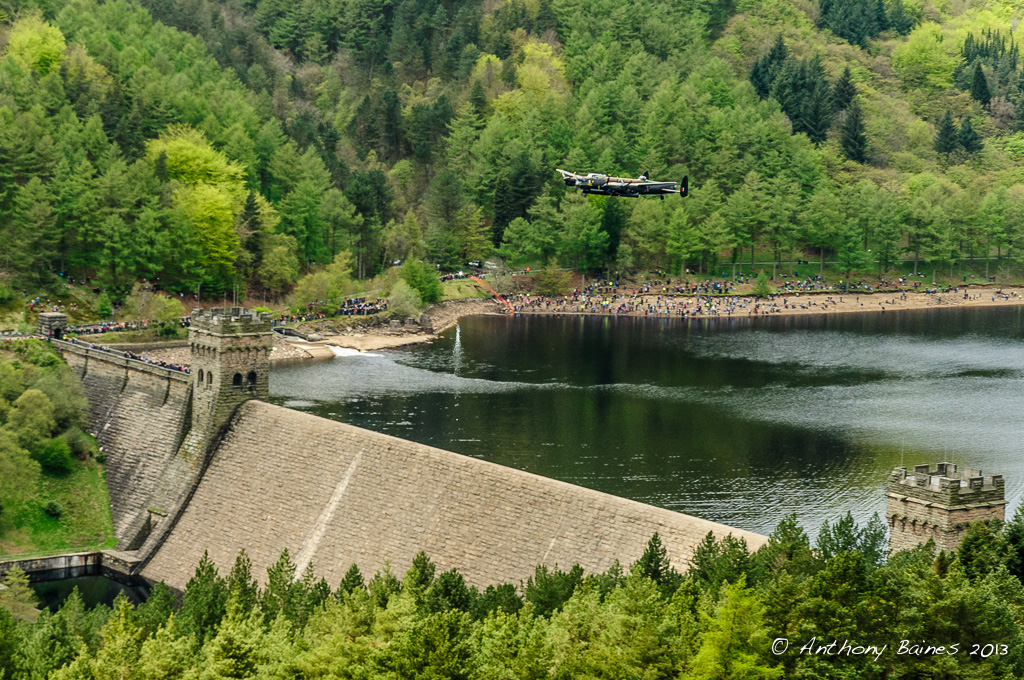
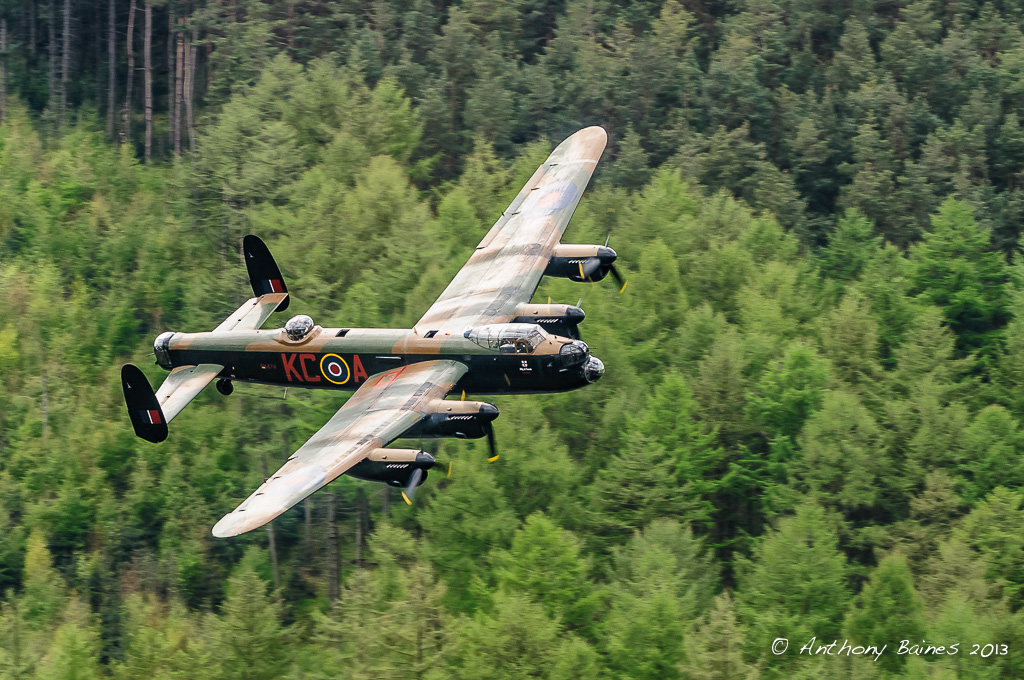
BBMF Lancaster over Derwent Dam
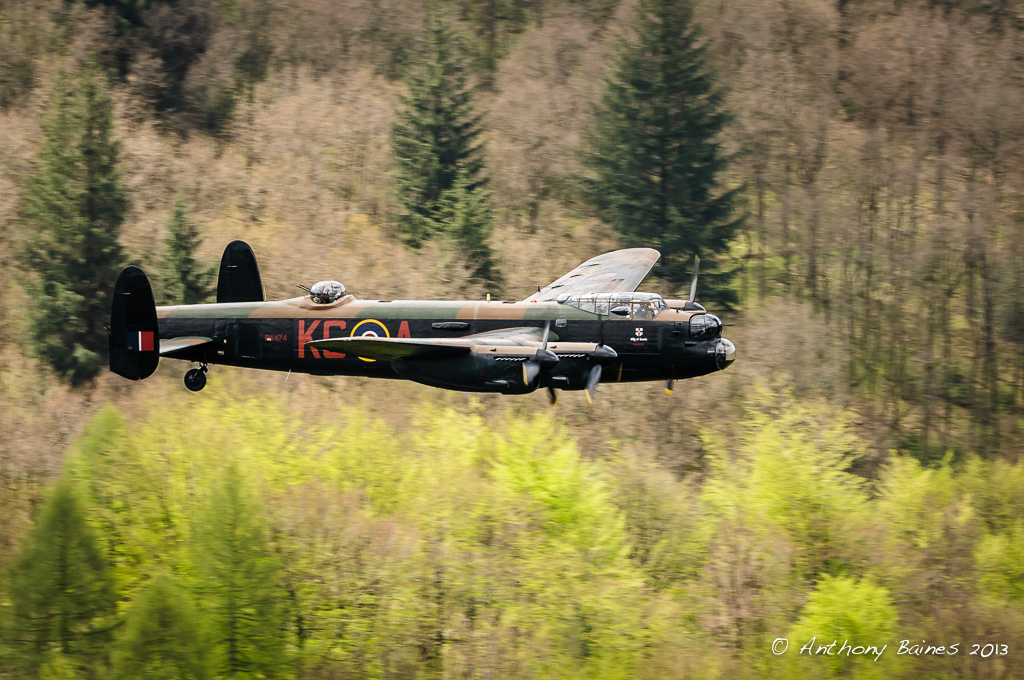
BBMF Lancaster on return run
Last Thursday (16 May 2013) marked the 70th anniversary of the famous Dambusters raid on the Ruhr dams by 617 Squadron using bouncing bombs designed by Barnes Wallis. Operation Chastise has become famous in years since (not least because of the film "The Dam Busters" based on the book by Paul Brickhill*).

The 70th anniversary represents probably the last time to get the few remaining surviving aircrew together for the commemoration. As such, it has become quite an event in the media this year, and the Battle of Britain Memorial Flight seems to have been working especially hard with events and fly pasts throughout the country.

I discovered last weekend that there was going to be an event at the Derwent Reservoir dam in the Peak District. The BBMF was planning to fly the Lancaster and a Spitfire down the reservoir to mark the fact that the Derwent Dam was used to practice the raid. They were to be followed by two of the current aircraft from 617 Squadron, Tornado GR4s. That was an experience I could not possibly miss, and so I booked the day off work and headed for Derbyshire.

I had read online that it was likely to be busy there and that car parking was extremely limited. I could see a spot on Google maps where I wanted to get to on a hill overlooking the dam, so I thought I would try and get there early so as to get up the hill in time to secure a reasonable place.

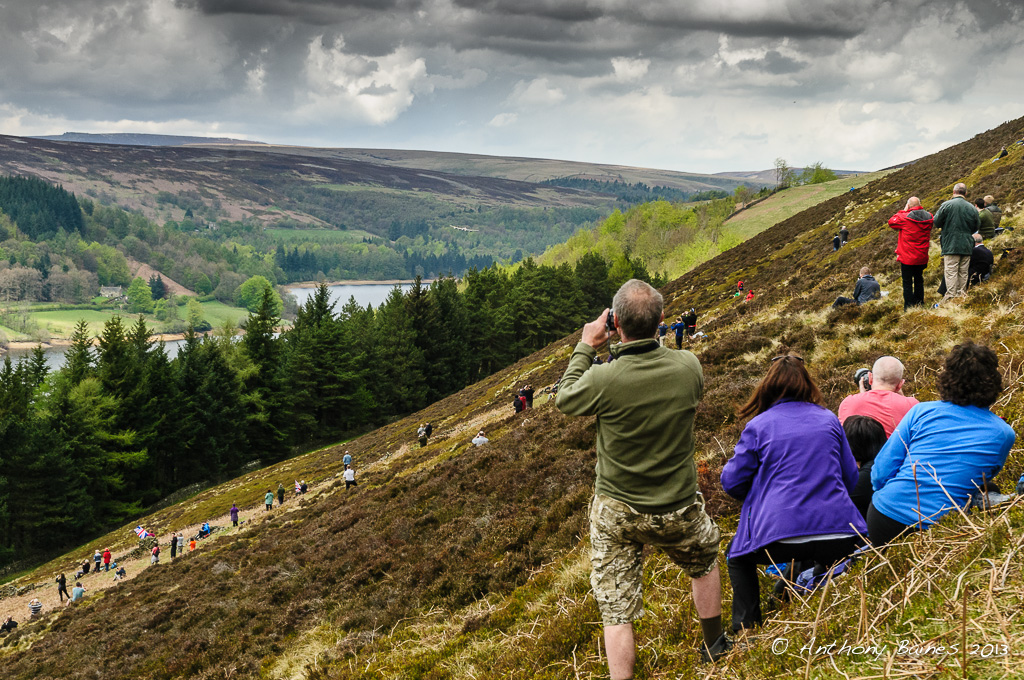
I arrived in the vicinity at about 8 o'clock to find that parking spaces were already at a premium. I managed to find the last parking space in a small car park about 2 km from the dam; there was a nice easy path along the lower reservoir up to the dam, so I had a most pleasant stroll along in the morning sunshine. Once at the dam, I made my way up the hill on the east side to the spot that I’d picked out. It was a bit of a slog uphill across the heather, but by 10 o'clock I had found my place. There were hundreds of others there already on that patch of hill, but I found a good vantage point that gave me the view I’d pre-visualised.
Derwent Reservoir. iPhone photo.

I had been dreading low cloud and rain, but luck held and they kept away. There was just a bit of broken cloud and no rain at all. Very little wind as well, so providing the Lancaster did not go tech, we could hope for a great display.

More and more people kept on arriving during the morning. I could see even from the hill that the double yellow lines were fully occupied by cars, and it looked as though parking restrictions had perforce been suspended to the day. Large numbers of people arrived by bike as well -- I could see streams of bikes from my position on the hill on the road across the other side, and a few people even carried them up the hill!

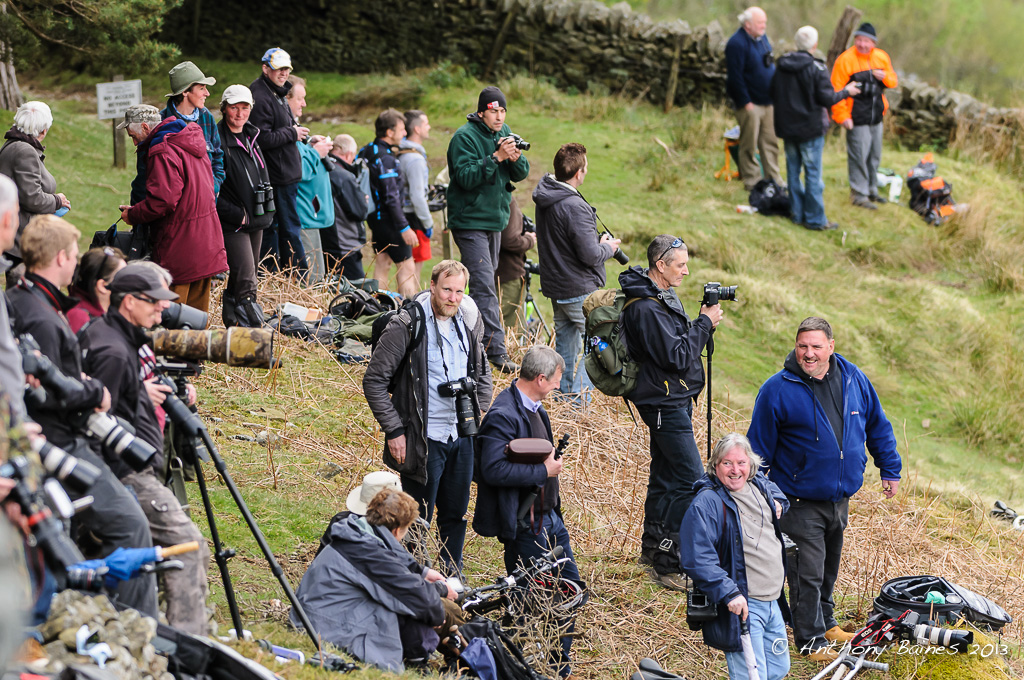
On the hill: spectators and their cameras.
Given that aircraft were involved, the Y chromosome syndrome had clearly kicked in -- most of the spectators were men. Nevertheless there were a number of families with children, and just up to my right was a party containing mostly youngish women who seem to be having a great time. There were even two large Union Jacks planted halfway up the hill carried there by spectators.

Something I enjoyed was just how sociable people were (yes, us miserable Southerners really are less sociable than those from Yorkshire and Derbyshire!) I chatted to various people on the way up and once I arrived, people around me were very happy to chat. There was a really good atmosphere; everyone was excited, as well as respectful, about what would unfold at 1 o'clock. The guy next to me had treated himself to a new Nikon D600 and a 70-210 VRII that he wanted to try out. His email address starts with Kojak - he is as hairy as the eponymous detective.

I had the fact that I had picked a good spot confirmed when a smudger from Getty Images turned up next to me: those guys tend to know their stuff. He has a pair of 1DX bodies and a variety of lenses that included one of the new 200-400 lenses that he'd been using in prototype for six months (coincidentally, the e-mail from Park Cameras had arrived the day before relaying the announcement of this camera at an opening price of 12 grand.) Wonderful lens was his verdict.

Periodically, I checked my camera. All that waiting was making me paranoid that when the Lancaster came and I got my only chance for a shot at have the camera set wrong and miss it. The point of the day was to get a picture of Lancaster actually over the dam, with the whole dam in the picture. I had not known which lens to bring to this, but fortunately I had brought my old 18-70 with the D300, and that allowed me to frame the scene exactly as I had visualised. I had the big telephoto zoom as well, and my idea was to get the various aircraft as they went over the dam with the 18-70 and then, if there was enough time between the aircraft runs, to swap on the tele zoom for some close-ups later. Check, check, check -- I think I must have used up much of my battery checking that I had enough charge on the battery, as well as all my settings -- shutter set to CH (continuous high), no exposure compensation needed, AF-C and so on. The big dilemma was about the choice of ISO and shutter speed. The light kept coming and going and eventually I settled on ISO 400. Shutter speed -- the thing is to keep evidence of prop movement, but the longer the shutter speed the more chance there is of blurring the plane. The other thing is that I wanted to show context, i.e. the dam had to be reasonably sharp and not simply a mass of motion blur. I started off on shutter priority at 1/250, with the plan to go to 1/320 when I swapped on the big lens. Generally, if I can, I'll go to something like 1/160 for the Lancaster, but today the priority was just make damn sure I got something sharp! I also set Aperture Priority mode for wide open, so that when the Tornadoes came through I could switch to A at full aperture to get a fast shutter speed.

At about 11:30 strains of a brass band began to waft across from the other side of the dam. I could also see a parade of some sort on the dam itself. I never did find out what it was, but "Onward Christian Soldiers" and "Abide With Me" followed by "The Last Post" must give an indication.

The first sign that something was on came with a pair of media helicopters arriving about an hour after that. They went out to a holding position out to the west of the dam. Everyone was sure that the BBMF must be on their way -- nobody could read tweets (no service on mobiles there) and there was nobody with a scanner around so I couldn't follow any progress. But promptly at about two minutes before the scheduled time of their run over the dam the distant shape of Lancaster appeared over the far hill. Unfortunately, its four Merlins were drowned out by the helicopters. I could see a blue Spitfire as well -- it had to be a PR Spitfire, very appropriate as one had brought back the famous pictures of the breached Mohne and Eder dams.
Err ... there is a Spitfire in there - honest! This was when I realised my original conception of the picture I'd come for might have some limitations :-)

At exactly 1 o'clock we could see the BBMF PRXIX approaching, making a fast run down the reservoir. As it approached the dam, I was surrounded by the noise of clicking shutters. The 1DX next to me chattered away fastest and longest, while Kojak next to me began to curse his new Nikon D600: he'd hit the buffer before he’d expected and his camera had simply stopped taking any more pictures as the Spitfire crossed the dam. The D300 worked perfectly and never stopped, so if the pictures were no good it would be my fault not the camera’s. The repair to it was paying for itself again. The only thing was that the Spitfire looked ever so small in my viewfinder, emphasising the relative scale of the dam and the aircraft.
People stood up and cheered as the Lanc began its run down the Reservoir
Soon after, the Lanc commenced its first run down the reservoir. Everyone stood up and cheered. I'm not sure of the height it was flying above the reservoir (400 feet?), but certainly higher than the 60 feet of the original raid. No matter as far as I was concerned -- it was there, and if it is being flown prudently that's good, because I'm hoping that my (still hypothetical!) grandchildren will also get to see it fly one-day. I got the shot I’d come for -- the Lancaster over the dam. I'm not sure whether Kojak did -- he was cursing the D600 again. Getty man seemed happy.

I quickly came to the conclusion, chimping on the back of D300, that now that I had the shot I was here for, there was really no future in keeping the 18-70 on the camera. One picture of a tiny aircraft against the dam was enough: the opening picture shows this.
BBMF Lancaster
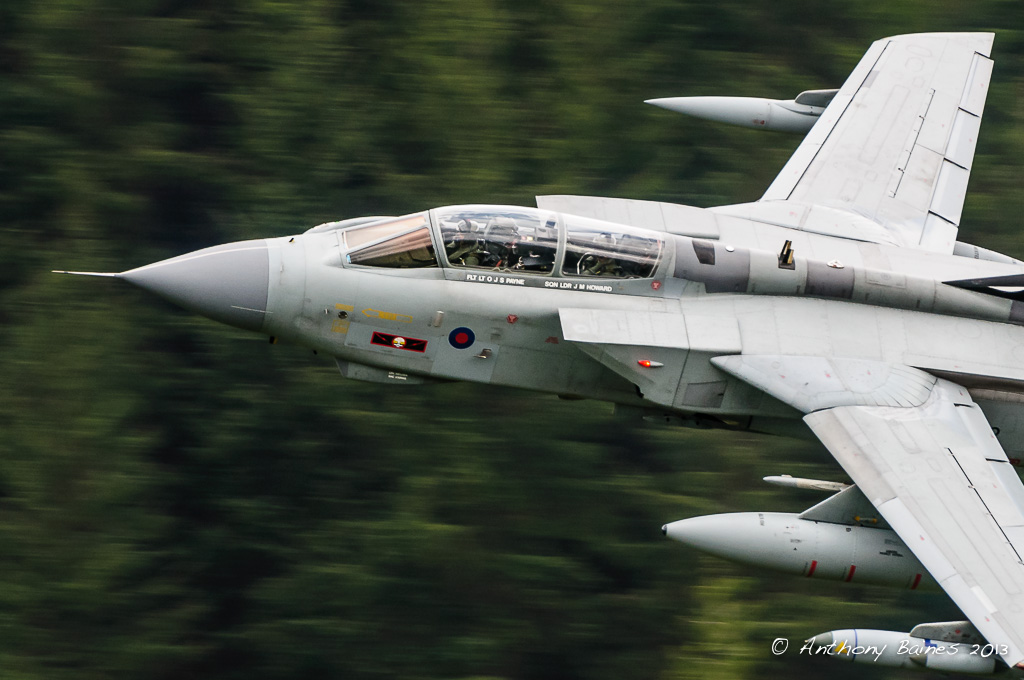
 Aviation geek took over, which means mucho telephoto. As a result, I already had the big lens on when the Tornadoes made their run -- in retrospect, it would have been nice to have a picture of the two of them over the dam, but I'll settle for the close-ups anyhow. In the rush, I forgot to change shutter speed, and kept it on 1/320. My experience has always been that panning fast jets at 400 mm with a comparatively slow shutter speed like 1/320 is a low yield procedure. These Tornadoes were going to provide me with my first views of fast jets below me against a background, so I would happily take minimal background blur in exchange the sharp pictures. I managed to keep up with the Tornadoes anyhow, and enough of the pictures turned out just fine in any case.
617 Sqn GR4
617 Sqn GR4 (1/320 sec)

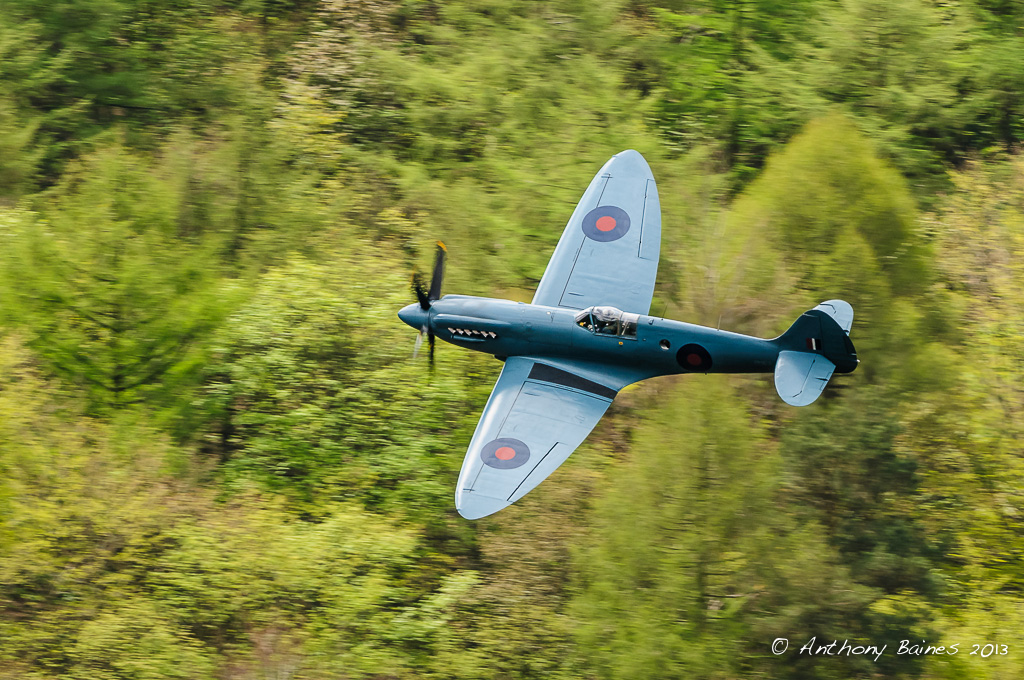
In the end, the Lancaster made three runs; down the reservoir, around and back up in the opposite direction, and then down again. The tornadoes also made three runs. The Spitfire followed the Lancaster on his last run down the reservoir, and because I was concentrating on the main attraction, I only got the Spitfire as it retreated. Nevertheless, a pleasing shot.
The Lanc runs down Derwent Reservoir, followed by the Spitfire.

BBMF Spitfire PRXIX

And then it was over. A 400 mile round trip and three hours sitting out on hillside for about 15 minutes flying. Bargain. Best value of the year.

I think in the end, everyone was very moved. Seeing the Lancaster actually flying over that dam brings home just what an extraordinary achievement Operation Chastise really was. This blog piece is already well into TLDR** territory, so I won't go any further with that thought except to say ... I'm very grateful, thank you.

Coming down the hill, there was one lovely moment. A young woman with vivid (almost fluorescent) red hair was talking to someone. "You photographers are indeed strange people. I'm going to tweet that when I get back to civilisation." Strange people? Can't argue with that.

~~~~~~~~~~~~

*If you are at all interested in the Dam Busters or 617 Squadron, I do recommend the Brickhill book. Still available in paperback. I know that it has been criticised for presenting an idealised version of events, but it is still staggering, not least in recounting the operations of 617 after Gibson. In any case, Guy Gibson's book "Enemy Coast Ahead" is also essential reading.

**Too long, didn't read.

~~~~~~~~~~~~

Update 4 June 2013. The opening picture shown the Lanc over the Dam has been chosen as a UK Airshow Review Picture of the Week for Week 20, May 2013.
http://www.airshows.co.uk/week-in-pictures/2013/may/ 

Sunday, 24 February 2013

Two years with wireless flash triggers

Transmitter and receiver. The wireless transmitter (left) is shown sitting on a camera  hotshoe. The receiver (right) is attached to a light-stand by a tripod-style screw attachment; a speedlight sits on a hotshoe on the receiver.

We don't do much on equipment on Wonky Horizons, but I'm making an exception here. This is not so much a review, but a commentary about two years experience with a set of inexpensive wireless flash triggers. I have mentioned these in a previous post, so this is by way of a follow up.

My Nikon D300 and D700 both have a pop-up flash that can be used to control an external flash, and send exposure commands to it. This is a great way to make lighting a subject using flash more interesting by moving it away from the camera. This is part of the Nikon creative lighting system (CLS) that allows full automation of flash exposure.

However, soon after I began using it with an SB900 speedlight (usually firing through a shoot-through umbrella), I realised a serious limitation. There is a tiny lag (only milliseconds) between the commander flash going off and the external flash firing. The delay is just long enough to allow the subject to close their eyes. My daughter, for instance, has the most amazing blink reflexes: pretty much every time I tried to use the pop-up flash as a commander she would blink, so every picture came out with closed eyes. I also think it is a bit unpleasant to have a hard small flash go off in front of your eyes during any extended portrait session.

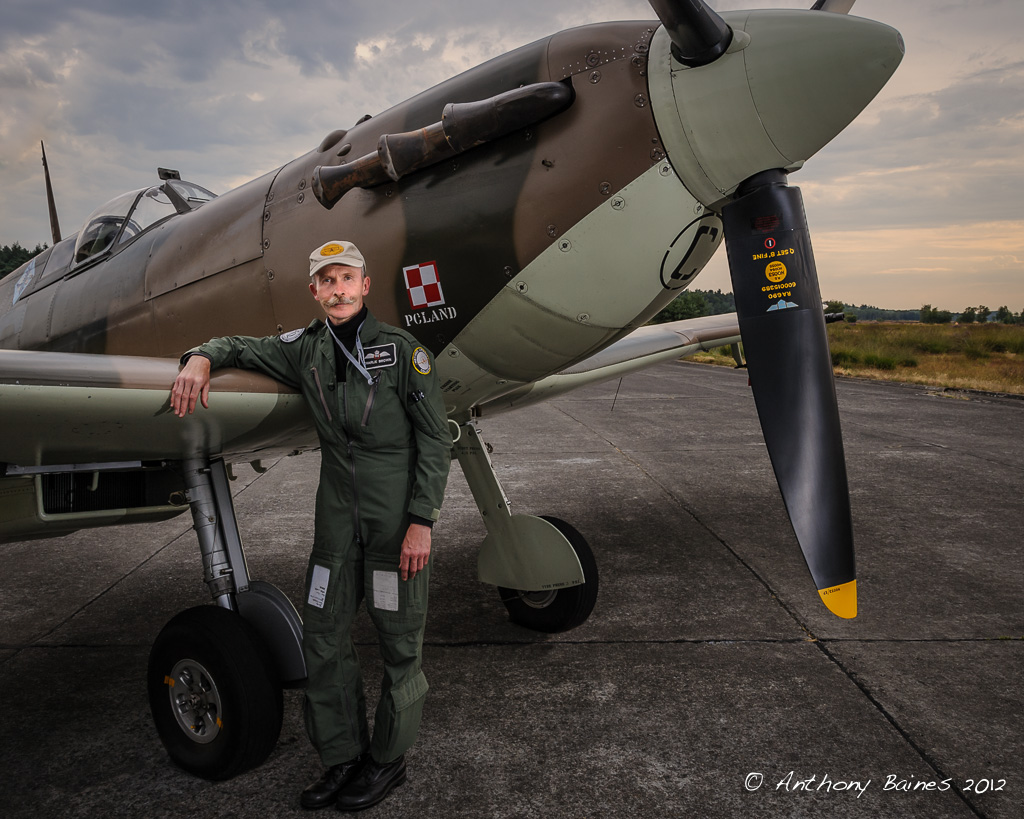
Charlie Brown, Spitfire pilot, with BM597. He and Dave Harvey (below) had flown in from Russia via Poland  to Belgium. He very kindly posed with his aircraft for a quick portrait. I added a little light from the SB900 held by another photographer acting as a voice-activated light stand camera right, triggered by the Yongnuo. The added flash makes all the difference to the picture by lifting Charlie from the shadow of the plane, while not over powering the remaining daylight. Camera and flash set to manual exposure.
I had been thinking about getting a wireless trigger for a while when I came across a video by Gavin Hoey, where he used a Yongnuo trigger. These are extremely inexpensive compared to top of the line Pocket Wizards, but, if they're good enough for Gavin Hoey, they should be good enough for me. I actually had the chance to talk to him briefly about them: he was very enthusiastic about them, and said they had been good value for money for him up to that point. So I ordered a set from Amazon.

The device consists of a transmitter (mine is a Yongnuo RF-600TX) that sits on the hot shoe of your camera, and a receiver/trigger (Yongnuo RF-602RX) that has its own hot shoe that attaches to the flash. There is a tripod screw mount in the base of the receiver, so the flash/receiver combination can be attached to the top of a light stand or into a umbrella/soft box support.
Dave Harvey, Hurricane Pilot.  Same set up as above, but a few minutes later, with the sun setting fast. Again, the SB900 was held camera right by a VALS (thanks, Daniel!)

In operation, they are simplicity itself. Switch on the flash and the trigger, and you're ready to go (the transmitter communicates with the hot shoe and doesn't have an on/off switch). The transmitter takes a CR2 battery, and the receiver one AAA. The set I got from Amazon had the batteries with it.

There's almost nothing more to say – they just work. Of course, the downside is that you lose the CLS control of the flash. That's to say the expensive, smart SB900 becomes a dumb slave flash. Bummer. But actually, in real life, this has been much less of an issue than I had anticipated. Having grown up with manual flash it's really not a big deal as far as I'm concerned for the kind of simple stuff I do. The SB900 has a very straightforward manual output power control: this means that it is very simple to set the power output to match the desired exposure. I usually work with the flash set to somewhere between 1/8-1/2 power to get a reasonable balance between short recycling time on the flash, and adequate control of aperture.

The range of the wireless signal is more than I'll ever need. I've no idea what the maximum range is: I've tried it over about 60 metres, and it worked fine, and that is far more than I've ever used in serious work.

One more thing to mention is that my son took them over for his A level photography work.  He liked them so much that he bought a set for himself to take with him to University. His Flickr stream shows he makes a lot of use of them.
From Peter's A level portfolio. For this one, the subject (who shall be nameless!) was lit camera left, through an umbrella outside in the garden, again triggered by the Yongnuo. Picture by Peter Baines.
After two years, all I can say is so far so good. They've worked first time, every time, up till now (says he, furiously touching wood!). Of course, I don't make very heavy use of them, and if I made my living using flashes, a set of Pocket Wizards would be a no-brainer.  But for me, these have been a great value purchase.

Sunday, 6 January 2013

Anthony's 2012 Favourites, Part 2: Aviation


 A bit late I know, but here is the second part of my 2012 favourites.

I've done so much aviation photography in the last year, that it seemed pointless to include my aviation favourites in with all the others. It also means I can be a bit more generous to myself in my selection of pictures.

There's probably too many highlights to list them all, but the big bucket list item was flying with the the HAC Hurricane and Spitfire, which I've blogged about previously. Too many great events to list here. But if you have a look at my Pbase Aircraft galleries, you'll see a selection of pictures from each of the events I've been to this year. (I've kept the complete aircraft galleries going on Pbase, and generally have only posted highlights across on to Flickr. Arbitrary and probably random decision about this - not sure whether I'll keep on doing that. Not to mention there's pictures from a couple of visits to Heacorn Aerodrome I've not even developed yet.)

As before, there's Flash slideshow of the set. If you're on an iPad or similar and Flash is not supported, I suggest going to the original set on Flickr.

Created with Admarket's flickrSLiDR.

And that's my 2012. Pretty good as far as I am concerned. And I'm hopeful that 2013 will bring some more good opportunities with it.

Happy New Year!

Thursday, 30 August 2012

Photoflying in Belgium 2012

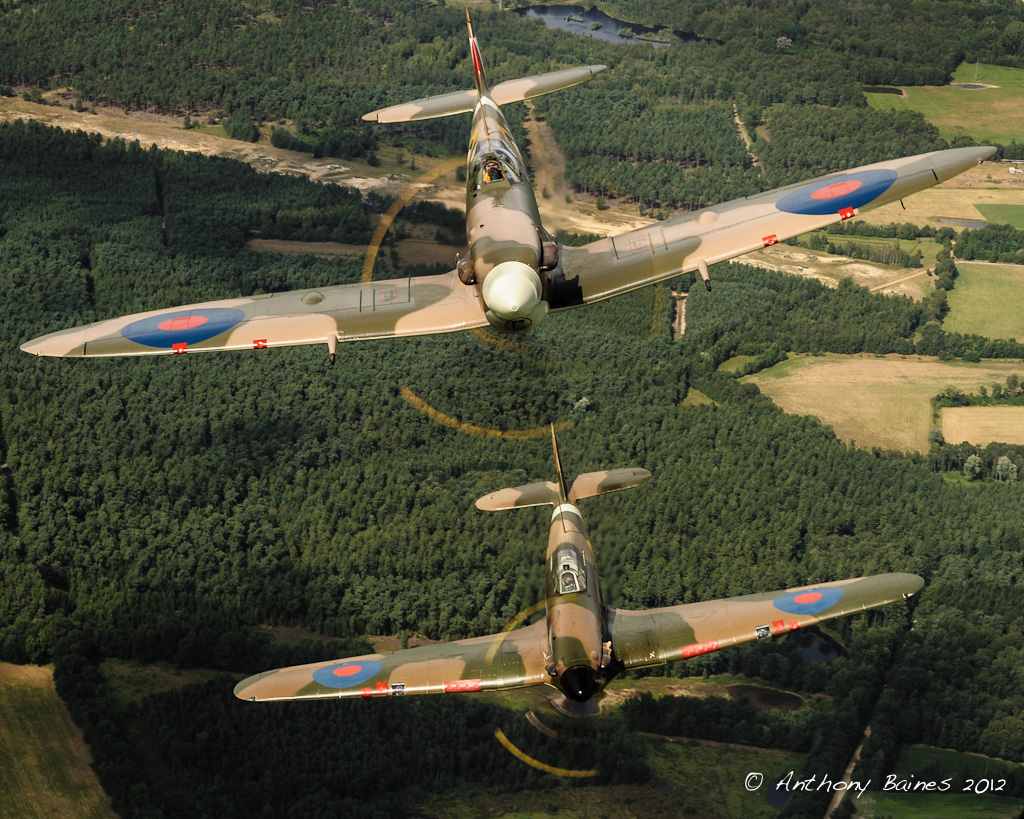
Spitfire and Hurricane, air-to-air

About 10 days ago, I returned from Belgium after this year's Photoflying days. My lack of blogging since then is not due to any lack of pictures from that time: I returned with a stupidly large amount (121 GB). I have spent such a long time sorting through the images, and trying to summon up the courage to write something sensible about a fantastic event, that I have rather been intimidated by the process of blogging.

I've edited enough pictures now to set up galleries on Flickr and Pbase.
Caught in the light: Spitfire Vb, flown by Charlie Brown
I was there for the whole of Wednesday 15 to Sunday 19 August. On Wednesday, a number of aircraft arrived including, for me, most importantly the Historic Aircraft Collection's Spitfire and Hurricane, piloted by Charlie Brown and Dave Harvey respectively. They had taken two days to fly back from Moscow via Poland where they had been attending the celebrations for the 100th anniversary of the Russian air force. We had a photo session in the evening with them and some re-enactors, which was great fun. Both pilots were in good form despite having long flights to get to Belgium.
Avenger in evening light

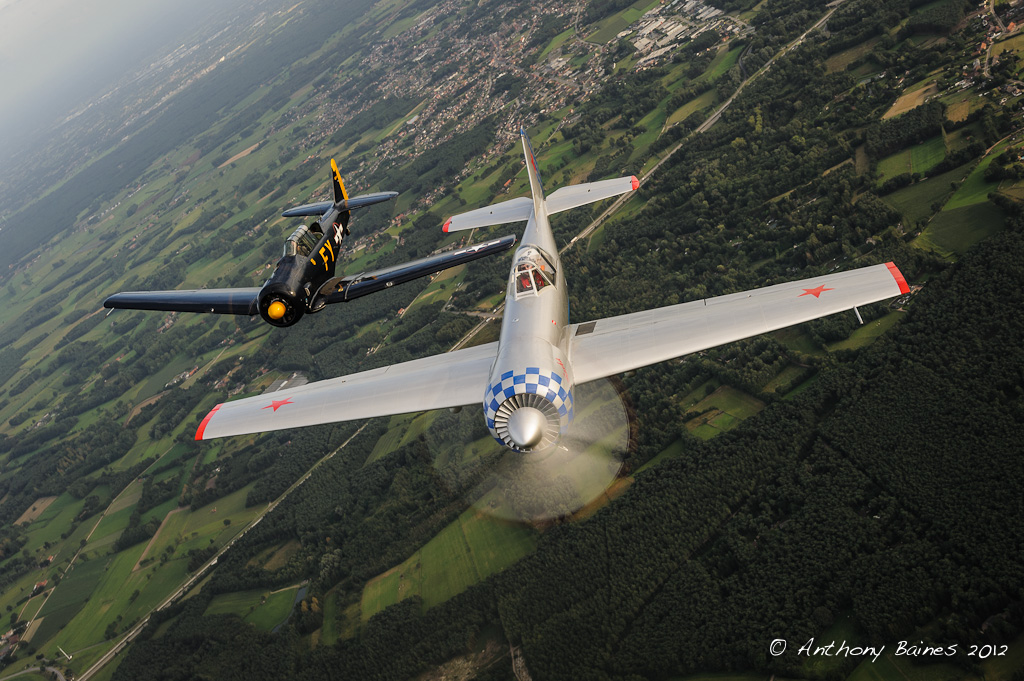
On the Thursday morning we all gathered: about 60 photographers, nearly double the number from last year. The event is clearly getting a worldwide reputation as there were attendees not just from all over Europe but from the US, Japan and South Africa. Flight planning began and to cut a long story short, I was lucky enough to get onto two flights that day. The first one was with the Spitfire and Hurricane, photographing them from the Skyvan. The second flight that evening was again in the Skyvan, photographing a selection of warbirds and historic aircraft, that again included the Spitfire, as well as an Avenger, Jet Provost, Yak-50, T-6 and Osa's Ark, the Sikorsky S-38.
(Left) Hanno in the AT-6A (right) Yak-50 Sasha
The Friday was taken up with largely ground-based photography, and slowly wilting in the heat. It reached the high 30°s C in the afternoon. The accredited photographers had a spot marked out about halfway down the runway where we could catch takeoffs and landings. But it was a long march (I think around 2 miles) from where the cars were parked, carrying gear (two cameras and lenses, including the 200-400 mm f/4) and as much water as would fit in a bag. Lots of great aircraft came through, so, despite the long round-trip, it was well worth it. A pair of F16s did a few great passes.
That evening, I positioned myself next to the taxiway to catch start-ups and departures for the photoflying, which again yielded rather a large number of pictures. There was a night shoot organised by Daniel Rychcick as well with artificial lights on the parked aircraft: I didn’t stay long as (a) I was exhausted and (b) wanted to get back early the next morning at sunrise to catch the early light.

On the Saturday I was up early (roused by a wretched cockerel that woke me each morning with the first faint hints of dawn) and on the flight line at 5:30 AM to catch the first rays of light on the aircraft. I spent a lot of time concentrating on Spitfire because I had an idea about trying to put together an A/V -- more on that in a future blog.
Janie: Etienne Verhellen at work
At lunchtime it was another flight in the Skyvan. This time with the classical civvies: Bulldog, Janie (the Yak-52 of Etienne Verhellen that I flew with last year), Chipmunk, Stampe SV-4c, and the AT-6A. It was wonderful to have Etienne behind the Skyvan as well: if there's someone who knows how to put on a show for those in the Skyvan it is Etienne. He left miles of smoke trails behind us as we flew, and did a very fast flick roll right up our backside that was great fun. Incidentally, I should mention that Hanno Wesdorp, who flies the T-6, was the hardest working flyer I have ever seen: he was up for all the photo flights, as well as flights intercepting arrivals for photography. Hanno is a wonderful guy, but he must really, seriously like flying to do all he did.
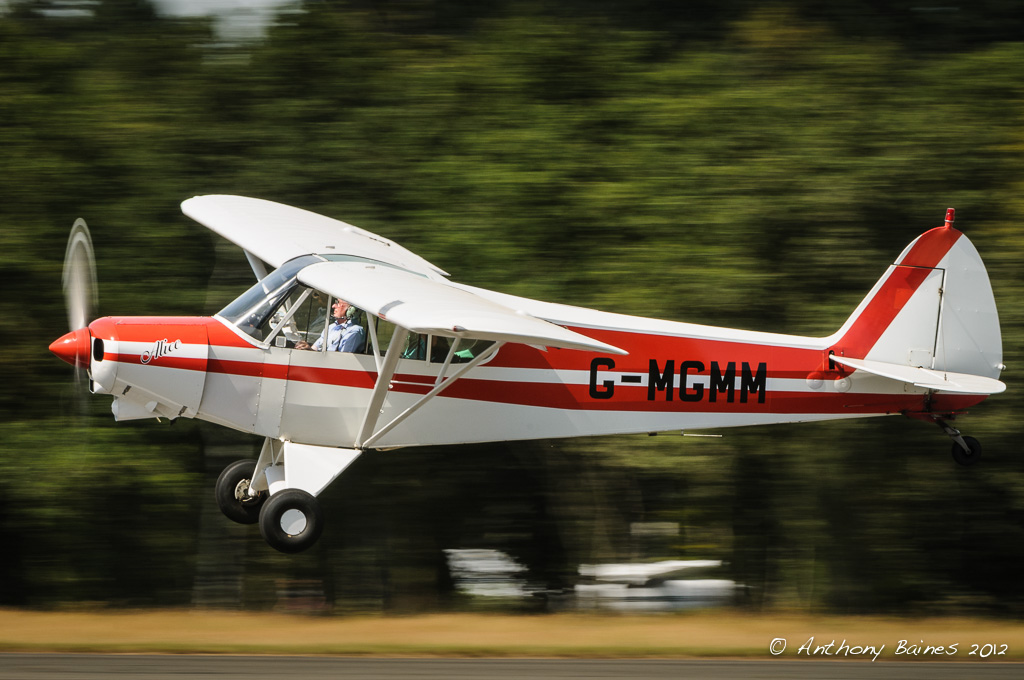
Rod Brown at the controls of Alice, Geoff Collins' Cub


Bulldog, photographed from Alice

It was also a pleasure to meet Geoff Collins again who was over with his Cub "Alice". Along with several others, I had been badgering him for a flight in her, so late that afternoon I was lucky enough to go up in the back seat with Rod Brown in charge at the front. We went for a 1-1 photo flight with the Scottish Aviation Bulldog. The light was gorgeous, and Marnix Tahon in the Bulldog flew beautifully, giving me plenty of chances for shots both on the front and rear quarters. It is a bit of a challenge though: I really wanted to get the full propeller rotation which means shooting at between 1/60 or 1/80 of a second. But the two aircraft are moving in space relative to each other and the Cub is vibrating and bumping around, so the rate of success is small. However, as McNally says, no pixels die in this, so there's no need to skimp on the number of shots. I got more than enough in the end to satisfy me.

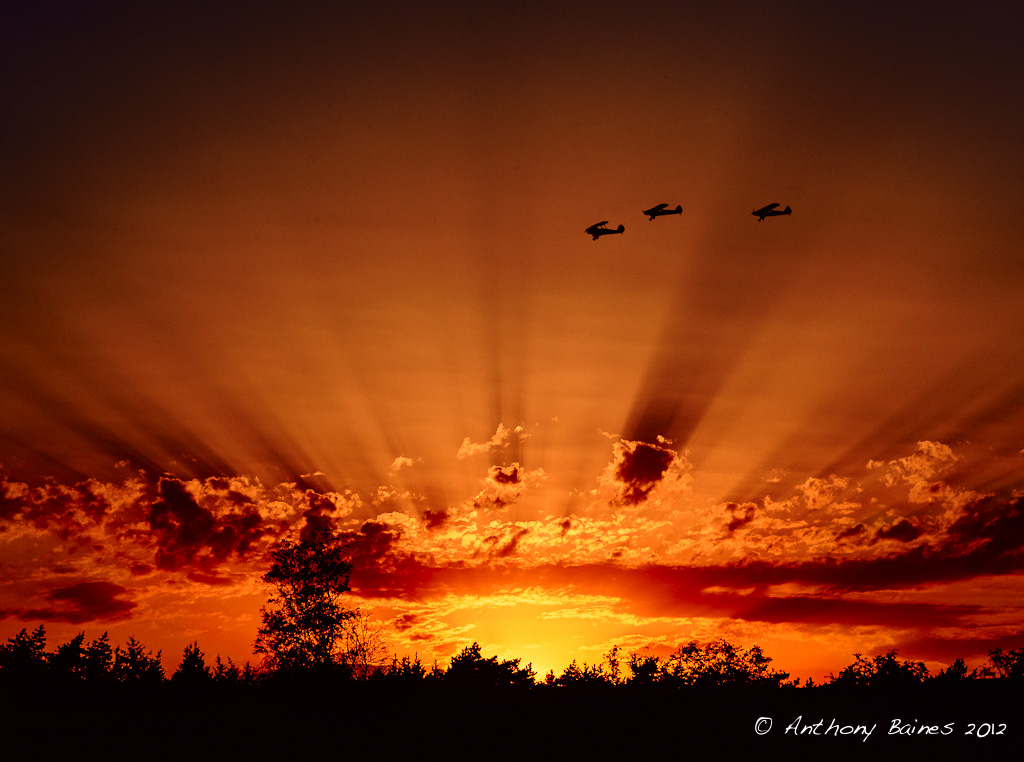
Sunset with vintage formation

Emerging from the Cub, the sunset was coming up, and it was starting to look beautiful. There was a vintage formation of small aircraft circling the field with a photoship in attendance. Rod Brown went up with another photographer to try catch the vintage formation. I stood with Geoff and watched as the Cub gamely gave chase. Meanwhile the sunset was getting better and better and Geoff and I said to each other "Wouldn't it be wonderful if that vintage formation went through the sunset?" And after a few minutes they did. The picture that resulted is one of my favourite sunsets recently.

Malle-Zoersel airfield in evening light. Skyvan (top), Breitling DC-3 and Osa's Ark are in evidence. Air-to-ground shot from Alice.

After all that, it was back for the farewell barbecue which was great, except that it was so hot that I had little appetite. The afternoon had got up to 40°C in the end, and we were all just about dissolving in our own sweat. Zoersel Malle airfield (EBZR) is also placed on a sandy plain so it was a bit like walking through a desert at some points. I was glad to get back to the hotel, shower and get to bed.

The Sunday morning was largely a case of hanging around taking a few pictures but with little specific in mind. Eventually, I left with plenty of time to drive back to the ferry at Dunkirk and I was home by 9 PM.

All in all, an utterly brilliant experience. It was exhausting given the possibilities of shooting from dawn to midnight, and enervating in the heat; not only that, but photoflying is the most expensive passion I can imagine coming across. Nevertheless, photoflying has been one of the great experiences of my life. Flying with the Hurricane and Spitfire has ticked an item off my bucket list.

My thanks go to Eric, Tom, Giel, Peter, Michael, Jesse and the rest of the Aviation Photocrew and their organisation. It was great to meet a large number of people I had seen last year, including Daniel Rychcick, Mark Salter, Andy Martin, Frank Grealish and Sonya Cooley, and Kedar Karmarkar who no doubt will write an excellent and much more comprehensive blog piece than me. Among the pilots it was a privilege to make the acquaintance of Charlie Brown and Dave Harvey, and to meet Etienne Verhellen and Jean-Michel Legrande again. I certainly hope to go back in the future.