Wednesday, 20 June 2012

A morning on the Kent Downs

We were blessed with a beautiful day yesterday and I got up early to make my way over towards some local orchid sites. First on my list was late spider (having missed early spider earlier in the year as I was away when they flowered).

I spent about an hour photographing a single specimen. This is the best of the bunch.


Later in the morning the wind got up, making macro work very difficult. Here's a common fragrant with a supporting cast of buttercups and others.


There were a few pyramidal in a sheltered position and I grabbed a few shots of these too.


Monday, 18 June 2012

Bringing home the RPS bacon


With Anthony recently being successful at Associate level with the Royal Photographic Society (RPS) there was a certain peer pressure for me and Philip to tread those same steps. We decided to submit a panel for the Licentiate distinction first, despite the fact that one can go straight for ARPS if so inclined (brave and foolhardy some might say).

Preparation


The most common method of attaining an LRPS is to submit a panel of 10 prints. It is possible to provide a set of digital images for projection but the pass rate is known to be lower and, as Philip and I are happy working in print media, it was a 'no-brainer'.

I started thinking about my panel seriously early this year and quickly settled on a theme with a three-row layout: a top row of nature, a mixed middle row and a bottom row of monochrome landscape. Philip and I each put a draft panel together, along with a few spares, and took it along to an RPS Advisory Day - luckily there was one nearby in Canterbury in mid-April. The day was led by Richard Walton FRPS and he gave each of us sound advice on our panels - in my case totally restructuring it by removing all the landscapes, changing from three rows to two and making the top row nature with a mixed lower row. It appeared to hang together well and I stayed with Richard's suggestions and re-printed and re-mounted accordingly.

Note: If you thinking of submitting a panel for assessment, attending an advisory day in advance is a MUST. You get to see examples of successful panels and get expert advice on your work from an RPS Fellow.

Assessment (judgement) day


Our chosen assessment day was last Thursday, 14th June, and we headed off to Bath the day before so that we could hand our precious cargo in the day before and spend some time taking some photographs around the City. I have some friends who live just outside Bath and they were kind enough to put us up for the night in exchange for a meal at At The Chapel in Bruton. Sue kindly offered to drive and we had a fantastic evening. A combination of a fatigue from traipsing around Bath and a few local ciders meant that we both slept really well the night before.

We headed off to Bath, parked up near to RPS HQ and found a delightful Italian deli for breakfast. On entering Fenton House we mingled with other equally anxious souls in the foyer before being invited upstairs to the assessment room.

We were sitting right at the back (~20m) from the prints so could not see them in great detail, awaiting eagerly for the panels to be hung. The chairman of the assessment panel introduced himself, gave an overview of proceedings, after which the other five assessors introduced themselves.

There were two digital entries which would be screened first, followed by the prints (about 30 I believe). The individual images are scrutinised and the overall panel is considered, after which the assessors form a huddle and fill in their score cards. Everyone holds their breath awaiting the outcome. One of the assessors talks about the panel highlighting its positive and negative merits before issuing their judgement, which takes the form of 'we are unable to recommend this panel' or 'is <author's name> in the audience'.

Well, the first two projected panels failed on technical reasons. No surprises there really. Then the first print panel went up. From the back of the room it looked to be a good one, made up of a set of interesting and well balanced prints. Then we heard those words again....'we are sorry but we are unable to ...........'

The next print panel came up and that failed - as did the next three. That made it zero acceptances out of the first six - ouch! You can imagine how we were feeling. Finally though, a successful panel. A huge sense of elation from the photographer and a slight drop of tension in the room. The next panel then failed! After that the pass rate was higher and, by the time we left at lunchtime the balance was around 50:50.

My panel came up around noon and I waited in anticipation for a couple of minutes (that felt like a couple of hours) before the assessor praised my panel and finished with those words 'is Martin in the audience' - deep joy and much shaking of hands.

We knew that there would be a break for lunch at 1pm and I could sense that Philip was getting more and more tense as time went on. It suddenly dawned on me that if Philip were to not make the grade we would have a thoroughly miserable journey back to Kent - he in despair and me racked with guilt.

At 12:50 Philips panel was displayed. I have to say, from the back of the room, it looked good. I was confident and I smiled at Philip who could not reciprocate. So many panels were failing on technical issues: not sharp, over-sharpened, colour casts, lack of highlight detail and poor print quality being the main reasons.

The assessor who spoke on Philip's panel enthused over it commenting along the lines of 'here is someone who's photography is in the same style as mine but who does it better'. A well deserved pass!

When we went to collect our panel we were asked by the RPS if they could hold on to our panel and use them as examples for use in forthcoming advisory days. We were flattered and left even more contented with our print boxes empty.

There had been one more panel before lunch (a quick celebratory drink and a panini) after which we decided we would depart gracefully and try and beat the traffic.

Our panels


Special thanks to


Philip for sharing the journey, including that last-minute sizing, printing and mounting.
Anthony for giving us the confidence and moral support
Ashford Photographic Society for providing a rich environment for us to develop our passion for photography
My wife Julia for putting up with my moods over the last few weeks

Friday, 8 June 2012

Simple intensification of blue skies in Camera Raw or Lightroom

Fig. 1. Belgian Air Force F16 displaying at Duxford, May 2012. (Left) Straight from the camera. (Right) Blue sky intensified as described in the text.
I'm sure this idea has occurred to many other people, but I've not seen it in any online tutorial specifically, so I thought I would post it.

When I'm photographing aircraft against blue skies, I like the blue to be really intense blue, a bit like the sky in high mountains (or, more prosaically, the effect given by a polarising filter). British skies are usually some pallid shade of blue (Fig. 1, left) rather than the intense blue I like (Fig. 1, right). So, for the last couple of years, I've been using a very simple way in Camera Raw and now Lightroom to intensify them. There are lots of other ways to do this, but this has the virtue of being simple and quick.

The blue of the sky sits conveniently within the colour range covered by the Blue slider in the HSL panel. The sky can be darkened simply by sliding the Luminance Blue slider to the left. Sometimes skies can have a bit of Aqua in as well, so that slider might have come down as well. The best way to do this is to use the targeted adjustment tool for Luminance and then drag downwards on the sky.

What usually happens when doing this, though, is that the apparent saturation of the sky increases to the point where it is not realistic. So now use the targeted adjustment tool to drag the Saturation on the sky down (maybe just a little) to the point where you get a fairly realistic looking intense sky.

At this point, all the manipulation to the sky can bring out a lot of noise. So it is necessary to add a bit of noise reduction from the Detail panel. It may be necessary to use both Luminance and Colour noise reduction.

For simplicity, I've set up a Lightroom preset that drops Blue and Aqua Luminance and Saturation and adds some noise reduction. This makes a good starting point for intensified skies, and typically does not require big moves on the sliders from there to get a satisfactory result. Fig. 2 shows the HSL settings for this.

Fig. 2. HSL settings for simple blue sky preset (Lightroom 4.1)
This works well so long as the subject aircraft is not bright blue itself -- and most that I come across are not. Even where an aircraft has, say, a blue stripe on it, the effect is not objectionable, and so generally does not require masking off.

Friday, 1 June 2012

Focus stacking wild orchids

Monkey orchid flower head: D300/ 90mm Tamron f/2.8. Focus stacked with Helicon Focus.
Orchids in the landscape. D300/Sigma 10-20mm f/4-5.6
As a follow-up to Martin's last post on photographing wild orchids, here are a couple of mine from this week.

The evening when Martin and I went to see the orchids was very still, so it looked like a good time to photograph them: even though the light was quite dim, the orchids were not moving in any wind, so slow exposures were possible. The sky was also quite bright, which gave the opportunity to open up the shadows in the orchid flowers by using a small reflector positioned at the base of the orchid plant.

I wanted to be able to get some close-up pictures of the flowers where the background was suppressed by being defocussed. The problem with this is that the orchids were in quite dense foliage, so to get an out of focus background means using quite a wide aperture. Correspondingly, there is then the problem of depth of field across the flower. As I have blogged previously, one solution to this problem is to use focus stacking. In this, a series of images is taken by changing the focus point through the subject, and then the images are combined in software (I use Helicon Focus) to produce a sharply focused image across the depth of the subject. The background is still so far out of the plane of focus that stacking does not change its smoothness.

We met Martin's friend Steve at the site, who was also out photographing the orchids. He is another Nikon user, and he offered to lend me his Tamron 90 mm f/2.8 macro lens to use on my D300. The picture at the opening of this blog post (upper picture) is a stack from one of the resulting series of images with his lens (thanks, Steve!). The images were all taken at f/5.6, which I chose to give a sufficiently smooth background, but with enough depth of field within the flower so that the individual planes of focus did not have to be impossibly close to each other. I set the camera onto manual control (aperture, shutter speed and focus), and then used the smallest possible movements of the focusing ring between shots to move the plane of focus across the subject.

Back home, I simply exported 16-bit ProPhoto RGB Tiffs from Lightroom, and popped them into Helicon.  As a first go at focus stacking orchids in the wild, I think it is not too shabby, and the Tamron lens seemed to live up to its very high reputation.

I had taken my own 60 mm micro-Nikkor: although that is a great studio-type lens for flowers, on this occasion I really feel that the extra focal length of the 90 mm was very helpful. It would also have been nice to be able to control the camera using automation to ensure even and small steps. Helicon Remote does this very well, but you need to run it from a laptop, and I have enough to carry without schlepping a laptop on countryside shoots! I see on their forums that Helicon are finding it difficult to adapt Helicon Remote to the iPad: I hope this can be sorted because I think that controlling focus stacking from an iPad in the field would be a very powerful approach.

I went back with Gina a couple of days later. She was also keen to see the orchids, and was an uncomplaining assistant with another shot. The evening we went back it was too breezy for focus stacking -- the orchids were waving around far too much. But the overall light was nicer, so I tried some pictures to show the orchids in their landscape setting (lower image, above).

My idea was to try to show the orchids (really quite small flowers) and the slope of the valley they are growing in. As I've mentioned previously, I have a predilection for using an ultrawide lens; I thought that by getting down to the level of the flowers, and as close to them as possible, with the Sigma 10-20mm lens set at 10 mm on the D300, it should be possible to show them in their context.

Several difficulties came up with this, not the least being that while the lens needed to be set on very close focus for the orchids, but I also wanted to show the extent of the valley. The simplest way to get the required depth of field was to use f/22. If you read the forums, you will be told in no uncertain terms never to stop down this far because diffraction effects will ruin the picture. And there is no question that this setting does nothing for the ultimate sharpness of the image. In general terms, it might have been possible to use focus stacking to achieve the extreme depth of field I wanted, but with the flowers waving in the wind I didn't fancy effects of ghosting. The other problem was with the range of brightness between the side of the valley where the flowers were and the sky that I wanted to include. The brightness range was in excess of four stops. So to get everything on scale with a correct exposure overall in a single image, I put a three stop graduated neutral density filter over the sky (which also impinges on the tree line), and then lit the foreground by firing in a flash through a large diffuser. The flash helped give the orchid colours a bit of pop. I am reasonably happy with the resulting image: it required minimal post processing, and just for tidying up. I suppose I could have HDR’d it, or blended several exposures by hand in Photoshop, but I’d actually prefer not to.

Thinking about it, I think these two pictures illustrate the way I prefer to work. I’ll assemble a picture in post-processing when I need to (there’s no better way to get the first picture than by focus stacking), but I enjoy the challenge of getting a picture in a single raw file if I possibly can, even if it means using a combination of ultrawide lens, tripod, remote release, flash and wireless trigger, diffuser and ND grad. Nothing’s simple!

Lots of fun, and thanks to Martin for getting us there in the first place.

Tuesday, 29 May 2012

Photographing wild orchids

Introduction

It's all too easy to be lulled into thinking that you have to travel the earth got get interesting photographs. For me, one of the joys of photography is that there vast array of subject matter on my doorstep. All one needs is a bit of imagination and a sense of adventure.

For instance, Anthony and I were on the North Downs in Kent yesterday evening photographing monkey orchid. As well as proving interesting subjects, the peace and tranquillity in the countryside at that time of day proved a real tonic after a hectic day at work. 

In contrast to this, we will be at the Folkestone Air Show on Saturday, with as much noise and raw power that one could want. Totally disparate subjects and environments with entirely different photographic techniques required - a challenge that we both enjoy!

My nature photography journey

I've been interested in nature from a very young age, with a particular fascination for birds. Seasonal, gender and age variation together with migration meaning that there's always something interesting around at any time of the year. I have been photographing birds seriously for about eight years now and last year I diversified and developed a passion for wild orchids. Living in Kent gives me lots of opportunities to capture images of these as there are a number of excellent sites in the county.

My bird photography is characterised by paying very careful attention to the background (diffuse but complementary) as well as rendering the main subject sharp, and my approach to photographing orchids follows the same principles. The advantage with orchids is that they don't fly away; the disadvantage is that they are static and can't 'pose' for you. So it's all about lighting and composition.

I very much like to photography butterflies but numbers are very low this year, I guess in part due to the very wet April.


My approach to photographing orchids


Everyone has their own approach and there's no right or wrong way; that said, some work better than others. Here's a quick check-list:

  • Do some research to estimate the best time of year to go for your target species. Some will only be in flower for a couple of weeks and this period will vary from year to year depending on how warm/wet the spring has been
  • Keep an eye on the weather forecast and plan your trip for when there will be light winds - ideally less than 5mph - you may think the flower head is not moving but it's the biggest factor leading to blurred images
  • Avoid bright sunny days as there is likely to be too much contrast to capture the subtlety of the flowers effectively
    • For the two previous reasons I prefer the hour after sunrise and the hour before sunset to maximise my chances
  • Equipment wise, an SLR/macro lens combination is preferred. However, any lens with a focal length above 200mm can give good results. A tripod and/or a large beanbag is a must, as is a reflector to push light under your subject when doing close-up shots (don't underestimate the value of these simple props)
  • Technically, I use mirror-lock-up in combination with a 2-second timer delay (although many people prefer using cable release)
  • I shoot in aperture priority mode, with apertures ranging from f/4 for the whole flower to f/16 for close-ups
  • It's then a case of composition and execution - carefully checking exposure, focusing and keeping those backgrounds nice and uncluttered!
  • Start wide and work in close - see the examples and comments below
Monkey orchid in their natural environment. Early morning dew still heavy on the vegetation. Note the different shapes and heights. For single flower and close-ups pick a good specimen!


Single flower in its environment. This was taken in direct sunlight - note the high-contrast effect which  is a bit heavy for my taste
Getting in a bit closer now and depth-of-field is much narrower. I like this representation as it focuses the eye on the orchid flower and stem, with a subtle, complementary background melting away
Just the 'flower spike' lots of detail becoming apparent now, with the individual 'monkeys' clearly recognisable. The background is complete mush but a very natural colour!
A single 'monkey'. You really need a macro lens to get in this close.
If you have never photographed wild orchids before I'd recommend you give it a try. You won't get it right first time but you'll start on a journey that is not only fun but it will seriously hone your photographic skills


Friday, 18 May 2012

La Corrèze #3

The Eyrignac Manor Gardens

The gardens are to the West of La Corrèze, actually in the Dordogne region.

When we had been in the area previously we had decided to visit Eyrignac Manor Gardens which lie near the town of Sarlat. The gardens are unusual in that there are very few flowers, with the emphasis being on structure, form and texture.

After a drive of around 1h40, we arrived just in time for lunch (never a bad thing in France) and promptly found a table in the restaurant and enjoyed a salad before strolling round. The photos don't need much explanation so I'll let them speak for themselves.


Photographing waterfalls

I've just posted on this article on my business blog for anyone who's interested in getting good shots of waterfalls.

La Corrèze #2

Meyssac (1st May 2012)

One of the things we like to do in France is visit the local markets and buy fresh, local produce. One of our favourite ones is in Meyssac, a small town perched on the side of a hill with a quiet and friendly feel. The local producers turn up every week to sell their home-grown produce: cheeses, fresh and cured meats, fruit and vegetables, honey etc. We stocked up on a number of these plus walnuts, walnut oil and vinegar. Unlike UK markets, the traders sell on quality, not price, so you don't necessarily get a bargain and it would be somewhat rude to try and haggle.

We put the food in the car and I spent a few minutes around the square taking some shots of town.

Meyssac street scene
Typical 'town house'
Different building styles on the same house
Windows and shutters
The church spire

Lunch

When we got back I knocked up a quick salad of goats' cheese, walnuts and red grapes. In fact, the only thing on the plate that did not come from the market that morning was the red wine vinegar in the dressing.

délicieuse

Tuesday, 15 May 2012

La Corrèze #1

La Corrèze


My wife and I have just returned from two weeks in the Corrèze departement of France, near to the town of Argentat, on the banks of the Dordogne river. Our home was a beautiful gîte with stunning views over the river valley (thanks to Sue and Pete for letting us stay there....again...)

The area has very fertile soil, with walnut trees everywhere. A wide variety of arable crops are grown too and one can see many small herds (8-12 head) of Limousin cattle, which are farmed for beef. There are very few, if any commercial vineyards to be found.

The area is popular for canoeing, with a number of companies providing canoeing holidays from their bases on the banks of the river. The river is also popular for fishing, with trout and grayling being the main species sought.

Our base

View from above the gîte looking north
As in the UK, April had been extremely wet and water levels in the rivers were unusually high, flooding out the local camp site.

Argentat

The town of Argentat lies conveniently about 4km upstream - perfect cycling distance - boasting a stunning waterfront with bars, cafés and ice cream parlours. The main town has a large number of shops and excellent restaurants.
Argentat from the road bridge looking East
Just above the town of Argentat is Le Barrage du Sablier, one of a number of hydro-electric dams that also  operate together to regulate water levels. The river here is about 100m wide and huge volumes of water were passing through.


In stark contrast, the view of the other side of the barrage is totally serene - like a millpond - with views to the Château du Gibael campsite.

View upstream from the barrage showing the Château du Gibanel campsite

Beaulieu-sur-dordogne

About 20km downstream of our base lies Beaulieu-sur-dordoge, a town that we had visited before and were keen to return to. We found a circular walk in a guide book from the market square that took us out into the countryside, offering great views of the river and the town below, before returning back to the town. The light was very contrasty so I used a polariser to hold in the highlights and sky.

View of the riverside walk - a footpath runs in front of the benches!


I was inspired by Anthony to take this image - a woman on her mobile outside of her cosmetic/perfume shop


Friday, 11 May 2012

Operation Olympic Guardian: Typhoons by night

ZJ933 is a Royal Air Force Typhoon FGR4 (11 Sqdn), at RAF Northolt during Excercise Olympic Guardian. Note: 36 Paveway II mission marks below the cockpit from the recent "Operation Ellamy", Libya.
As part of the preparations for this summer's London Olympics, a great deal of effort is being expended on developing the security for the games. Part of this is to put in place air defences in the London region, and at the time of writing a number of exercises are being staged. One of these is Operation Olympic Guardian, in which a number of Typhoon aircraft are being based at RAF Northolt in West London. I was lucky enough last night to be invited along to take photographs of them.

I shall put most of the pictures on Pbase, so just a couple of pictures here for now.

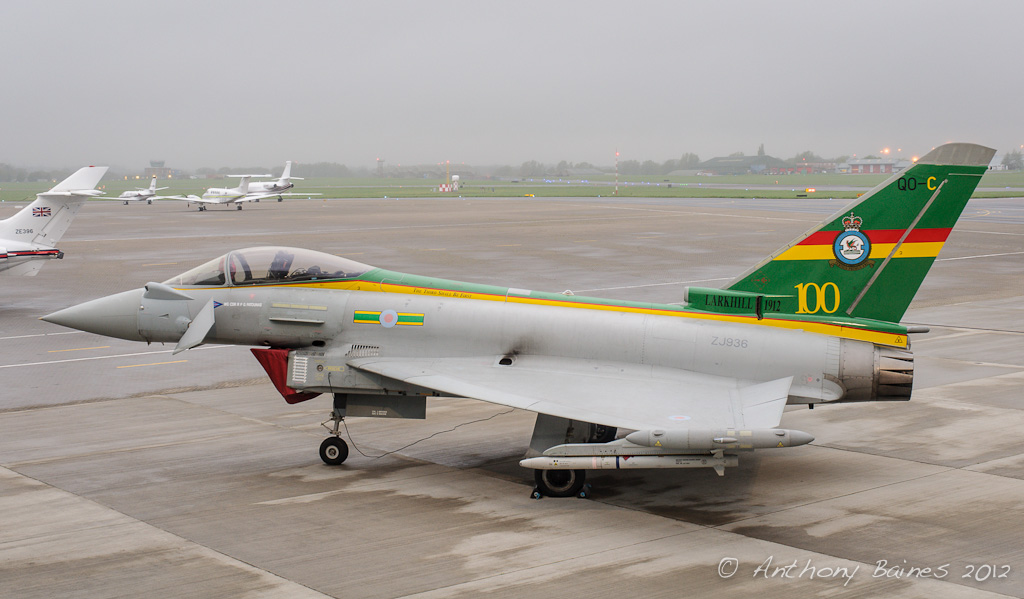
Just as the rain was coming in - the grey in the distance is the rain approaching. Eurofighter EF-2000 Typhoon F2 ZJ936 is the 3 Squadron 100th anniversary scheme Typhoon.
As the evening wore on, the rain started to tip down. By the end, it was torrential. But aside from (a) getting soaked and (b) having to wipe the front element of my lens every couple of minutes, the rain gave us great reflections on the ground. The aircraft are only illuminated by dim hangar at lights, so the exposures were the order of several seconds at ISO 200/F8-F11; with rain blowing horizontally, the lens eventually needed wiping after nearly every shot. Fortunately, I had taken a small towel with me to wipe off the camera gear in anticipation of rain, but in future I shall take more lens cloths with me -- I only had one and by the end it felt like I had dried off a whole family's washing up.
One of the locals - HS-125 ZE395 being towed into a hangar
This shoot was part of the Northolt Nightshoot series which I have been privileged enough to attend over the last couple of years. My thanks go to Squadron Leader Philip Dawe (the Graff Zeppelin!) and all his colleagues at Northolt for the invitation and for his terrific work in organising the event.

Monday, 7 May 2012

Funerals and the family archive

I haven't blogged for the last couple of weeks for various reasons: the main one being that my aunt who lived in Sussex died recently, and, with my brother, I had to organise the funeral.

Among other things, I put together a eulogy (tribute? I'm not sure what the right word is) that I read out at the funeral service. It is one of those occasions where it is critical to come up with not just the right words and emotional response, but also to tell the story of someone's life and their contribution. It helps to have quite a lot of key facts and dates to hand – and there were too many gaps in my recollection. Fortunately, my bother and sister-in-law could fill in a lot, and  discussions with other relatives brought more perspective too.

Events like this always make me go back to the family archive of pictures, and other sources of memories. Something that was nice was to be able to gather a bunch of pictures to put on my iPad to bring along to the wake afterwards.

As I've mentioned previously, I'm slowly scanning some of the film archive, so it was easy just to pop some on the iPad. I found a couple more pictures that were interesting the day before the funeral, and scanned them too.

One of them is of a gathering for my grandmother's 90th birthday, nearly 30 years ago, and taken on my aunt's camera. The original is awful, and showing bad signs of the colours deteriorating. But a little work in Lightroom brought the colours and contrast back well enough, and even though it is not very sharp, it is sufficiently clear.

The picture got a lot of interest, with us trying to work out who everyone was: most were easily identifiable (even if half have now died), but one person, although we recognised her, just could not be placed. Even if it has none of the technical qualities one would expect of a current picture, and it would interest no-one outside our family, for those present at the funeral last week, it was one of the most important pictures I took along.  (I'm also the only member of the immediate family not present – I'd recently landed in Baltimore – and this only makes the picture more interesting to me).

So, that experience just reaffirms for me some things that are intuitively obvious, but worth restating:
  • Never, ever, neglect taking straightforward, standard family pictures, even when you think you should be making winning art instead: family pictures are much more important and lasting in value.
  • Annotate everything!
  • Keep records of key dates (even, or perhaps especially, if they're not accompanied by any kind of photographic recording).
Annotation is easy in the digital age. For a start, dates are recorded in the EXIF anyway. Fortunately, quite a lot of the family archive has dates written on the back of prints: for instance, the date of my Grandmother's 90th party is written on the back of the print.

In Lightroom, it is easy to add a description and keywords, which makes finding pictures so much easier than looking through albums of prints and files of negs. These descriptions persist into the metadata of the exported JPGs which I'm emailing to the family (OK - this is only useful if people know how to view basic metadata, but at least is there).

The other thing is key dates. Paper diaries still work perfectly well for this. However, I've pretty much gone over to Google Calendar for both work and personal purposes. I think it should be possible to use Google Calendar as regular journal by adding notes to the description field for any event. Easily searchable, I hope, for the foreseeable future, and from any internet-connected device; the problem is that no-one knows what Google's future holds, so the longevity of such data remains to be determined. The other thought is just how much personal info should you put out onto the intertubes? Once out there, even if it is password-protected, the family history then has to be considered searchable by anyone. As much as anything, that's why I don't do Facebook. I suppose that Facebook in the end will take over all these functions (for as long as it exists …).

~~~~~~~~~~~~~~~~~~~~~~~~~~~~~~~

I've hardly been taking pictures recently. The weather has been pants. We've had two very dry winters in a row here in Southern England, so there's a hosepipe ban on. As soon as that was introduced, naturally, the rain started. So now there are floods. The bluebells are out, but I've not had a chance to make my annual pilgrimage to the woods to photograph them. Usually, I stop a few times on the way home from work to take pictures of them, but it has been just too wet. This week, with luck, I'll get to them.

Monday, 16 April 2012

In praise of the ultra-wide

St David's Cathedral, Wales. Sigma 10-20mm @10mm.

One of the first lenses I bought to use with my original digital SLR (the Nikon D70) was the Sigma 10-20mm f4-5.6 DC HSM. At the time, it was much less expensive than the Nikon alternative (12-24mm), and was well reviewed. As it turns out, it has been one of my most used lenses for nearly 7 years. I've just returned from a break with the family in West Wales, and of all the lenses I brought with me, this is the one that stayed on the D300 most. Even though I bought it as the budget alternative to the Nikon, no-one has ever complained about the quality of prints I get from it, and they evidently pass PAGB and exhibition quality thresholds.

The thing about ultra-wides (by which I mean lenses that are wider than about 24mm on 35mm format or 16mm on DX crop-frame) is that they represent such a departure from the normal way of seeing that they can add drama to a scene. I've been an addict of this for many years. I had a 24mm lens for my film camera, which is at the beginning of ultrawide - it is quite easy to add a bit of an edge to a scene with that focal length. Although it is only a few millimetres wider than a 28mm, the 28mm focal length has never done anything for me; I never owned a 28mm film lens, even though this seemed to be generally very popular. The DX equivalent of 28mm is about 18mm, which is the widest my standard 18-70mm zoom goes: it is a bit of a blah focal length for me.

The most common use of a wide angle is to "get it all in" - and there's nothing at all wrong with that if that is what the scene demands. This idea though seems to get poo-poo'd on the forums: it is somehow what your granny would do. The problem that many people have with wide angles is that, while the subject may be wide, it may have no great depth, so it just gets lost. Getting-it-all-in still means being able to make the most of the subject in a wide and deep frame.

The common mis-perception about wides is that they are just about width: that is not the whole story at all - they could just as well be named depth lenses. By putting an interesting foreground element in front of the general scenic view, a sense of scale and perspective can be created. This is also a way of giving context to a foreground element.

Here are three pictures I made in Wales with the 10-20mm lens. The opening picture, above, is St David's Cathedral - a classic case of getting-it-all-in. The town of St David's crowds close in on the Cathedral, and so the only way to get a clear view is close up. The picture was taken standing on a wall above the cathedral - the cathedral is so big, I was actually surprised to be able to get it all in.

Thrift, St Anne's head. Sigman 10-20mm @ 14 mm.

The flowers were on a cliff top path at St Anne's Head. I think a simple close up with a normal lens, although it might have revealed more petal detail, wouldn't have been so pictorially interesting, nor would it have shown the context of the flowers.

The last picture here was taken on a beach at sunset using a long exposure to get a misty effect on the water: I added a 3 stop Lee ND filter to lengthen the exposure, and a 3 stop (0.9) Lee hard grad to keep the sky on scale. Straight out of the camera with minimal Lightroomery.
Sunset. Sigma 10-20mm @ 10mm.