Thursday, 19 July 2012

The busy aviation photography week: Part 3 RIAT


Boeing F/A-18 Super Hornet on a fast pass
RIAT is the big one of the year for me: several days of having my ribs rattled by high performance jets screaming over just above my head. I always take far too many pictures, which I never really finish editing. Anyhow, of those I’ve looked at so far, I've posted a gallery of this year's pictures on Flickr. (FWIW pictures from several previous years are still on Pbase).

This year's show was great, in terms of the aircraft and flying. Great variety, with some types (like the Osprey) that I've never previously seen. But the weather this summer has been miserable, with the jetstream stuck in the wrong place, directing cloud, cold and rain at us, and only rarely letting the sun through. Great flying, but grey skies don't make for attractive backgrounds to pictures. I was there from Thursday afternoon to Saturday, as I'll recount below.

Arrivals: Thursday

This year I was able to get there for the Thursday afternoon of the arrivals. Yay - it was hot and sunny! For the Thursday afternoon the weather relented, and I joined Graham (Flickr:nacl1) in the field at the end of the eastern end of the runway.

There was a wonderful selection of aircraft arriving of the sort that you never normally get to see, including some of those truly garish paint schemes that come up each year at RIAT.
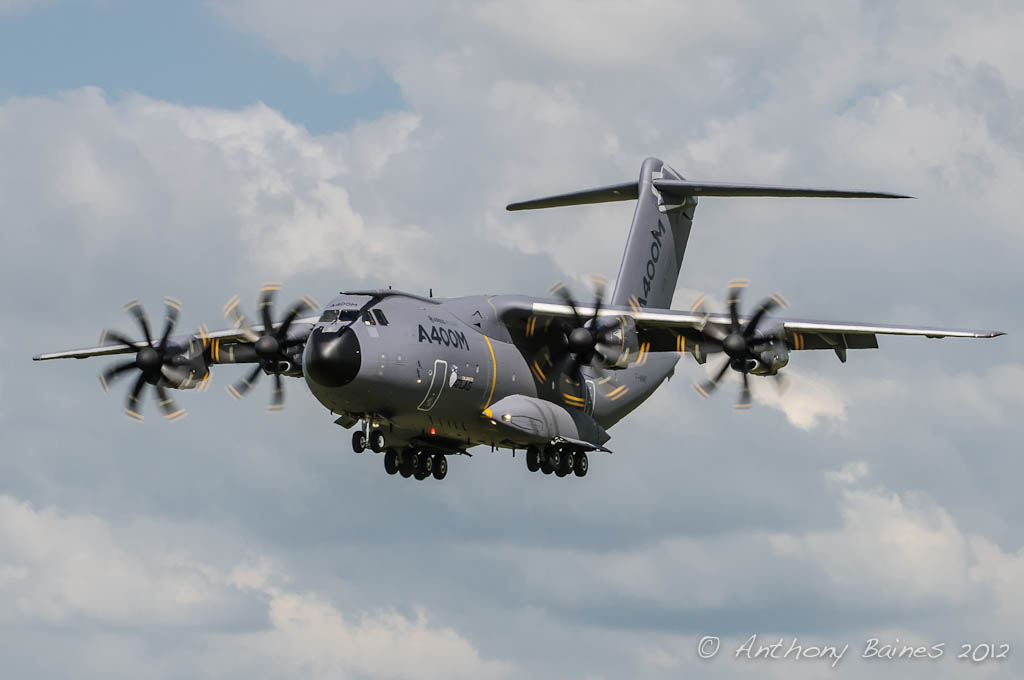
The Atlas Arrives

 The A400M is the new military transport, now named Atlas. A huge monster.

Tiger Tornado
 I did like the look of this Tiger Tonka.

Etandard

The skies were starting to cloud over when this Super Etandard Modernisé arrived. Bearing in mind this year's anniversary of the Falklands conflict, this type has a pertinent historic significance.
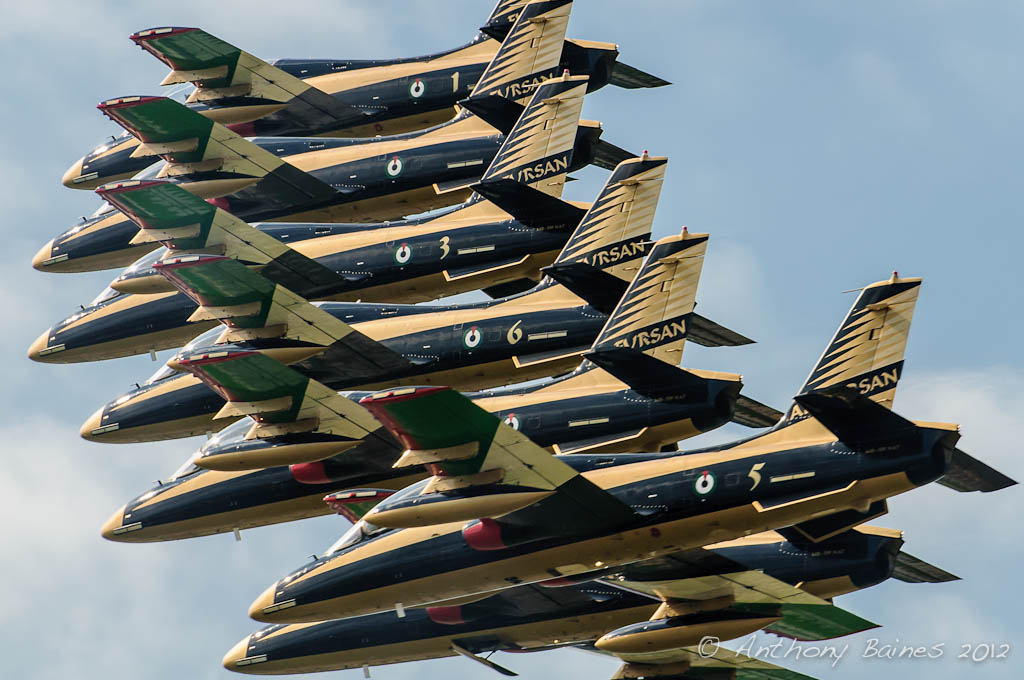
Al Fursan stack
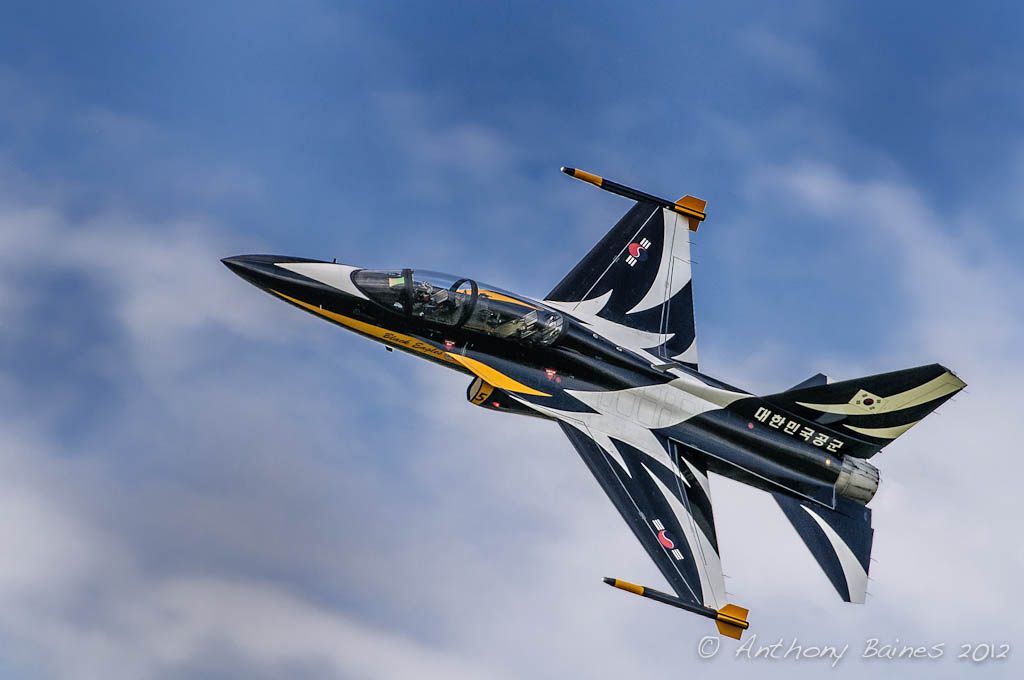
Black Eagles T-50

Several teams went up for practice, including Al Fursan from UAE and RoKAF Black Eagles. The Black Eagles, in particular, put on an excellent display culminating in drawing a yin-yang sign against the blue sky -- unfortunately I only had the 200-400 mm lens on at that point, and the sign was too big to capture with that lens.

All in all, a glorious afternoon with some wonderful flying.

Practice: Friday

The weather on the Friday was simply and straightforwardly pants. There's not many pictures to show from that day, even though we did get a little bit of flying. I spent most of the day in the car sheltering from driving rain, while the occasional aircraft went up to see if there was room under the cloud base for practice. I was most impressed with the way that the Korean Black Eagles went up to probe the cloud base: they disappeared at about 400 feet, but nevertheless kept looking to try to put on a display, but in the end had to admit defeat. Later, the team captain came on Wings Radio, the RIAT FM radio station, to apologise for the “inconvenience”. We were all slightly gobsmacked about such a wonderfully polite apology, when we thought we should be apologising to them for our ghastly weather.
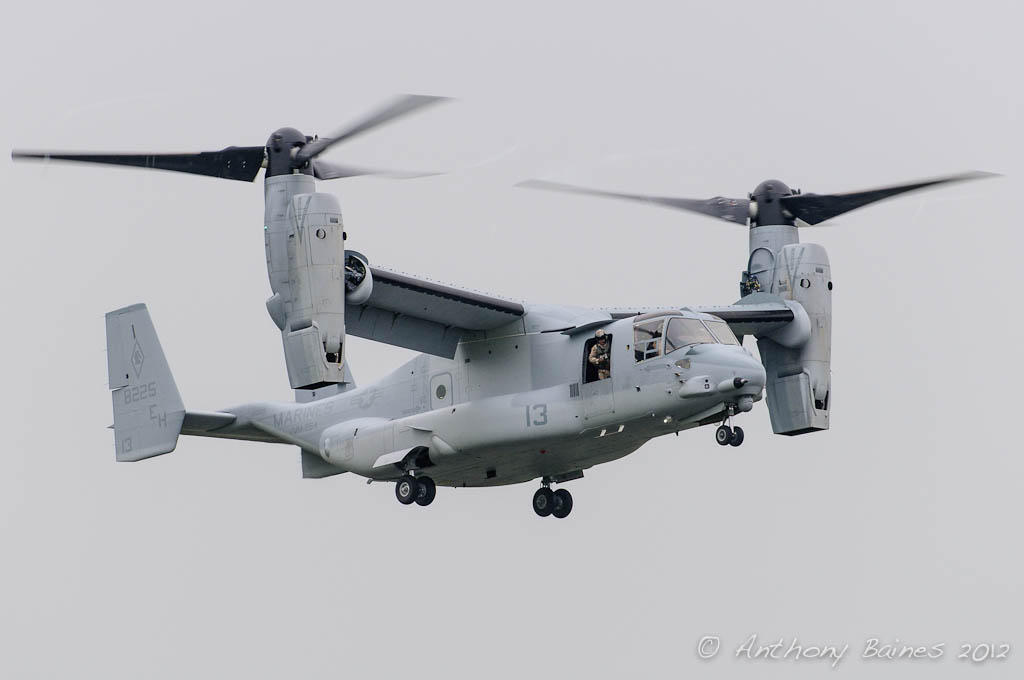
Bell Boeing MV-22B Osprey of VMM-264
 I did at least get a sighting of the V22 Osprey: I've never seen one before. Most impressive.
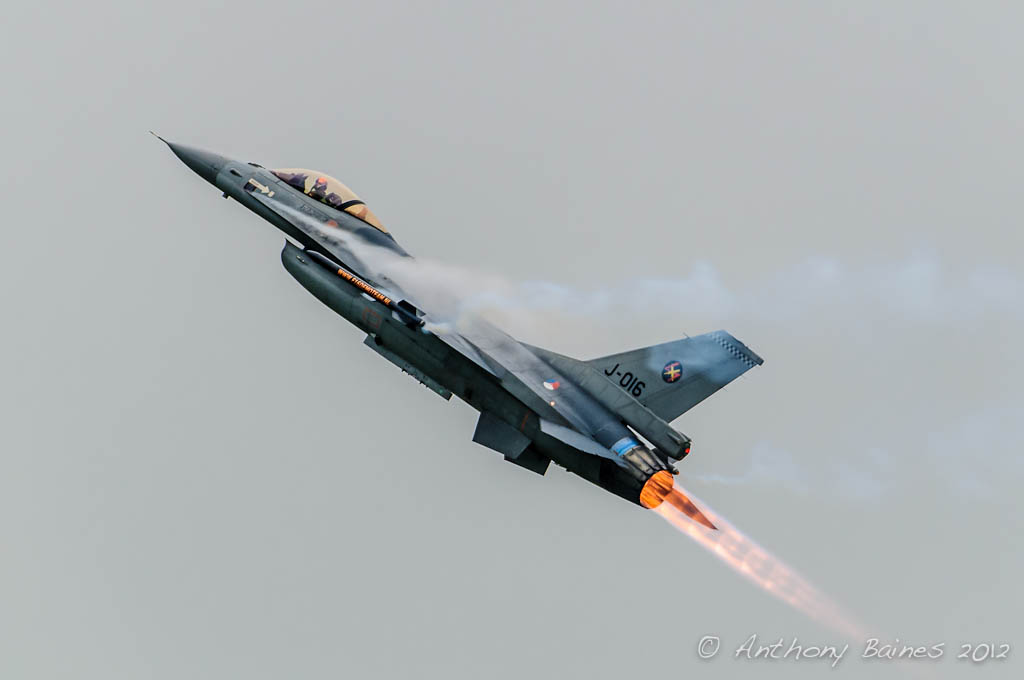
Dutch F16 in the gloom
One practice that did get going at least was the Dutch F16. The pilot, Stitch, very bravely went up late in the afternoon to try a practice display. The light was so awful that his burner stood out brightly against the dark grey sky. At one point, he appeared out of the clouds and found himself still heading down at very low altitude: his wings wobbled as he pulled up as hard as he could. For a moment we all thought he was  going to end up in the pond by Rhymes Farm. As I understand it he was immediately given a red card by the controller and had to land. The Dutch team tweeted about it later. In the field, we were all joking about Stitch having to go off and land so he could change his trousers after that.

Display day: Saturday

Arriving for the day, I was worried we will get no flying at all. The cloud was again low and the rain was coming in. However midmorning, the Ospreys started to move and I got some nice vapour pushed down from the rotors. Later on the sky transiently showed some blue stuff, when the clouds got out of the way: not often, but once in a while.
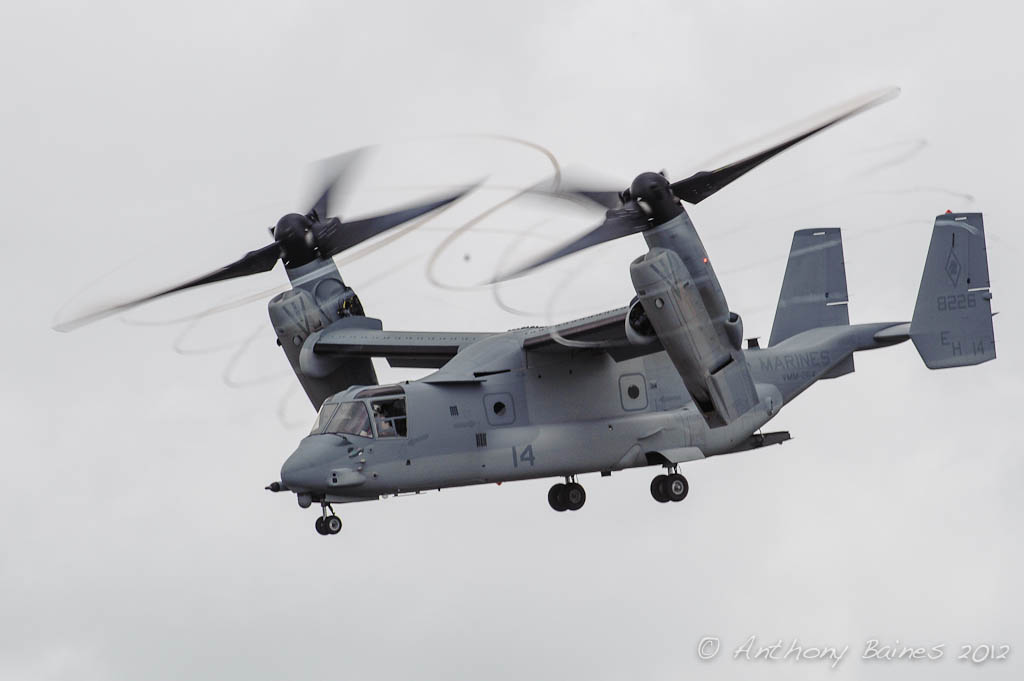
Osprey with vapor

After that displays came up one after the other, although mostly they had to run a low rolling display. The Korean Black Eagles again did a wonderful job, and I hope they come back soon.
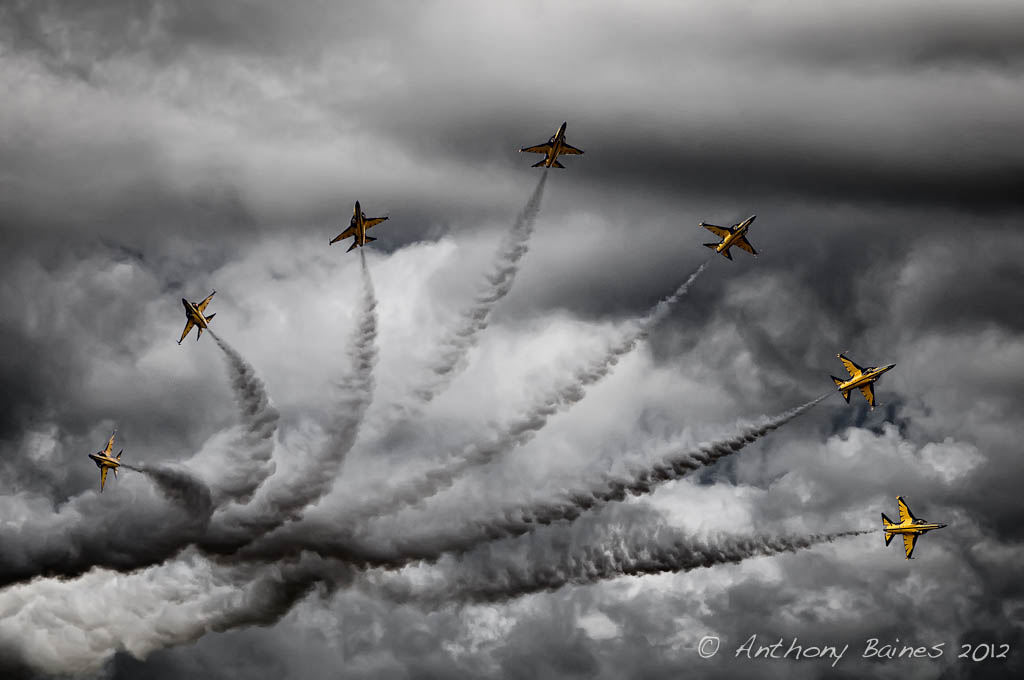
Black Eagles Burst. And I haven't desaturated the sky: just increased contrast with an L channel curve. It looks like colour popping, but isn't. The sky really was that grey!

I'll just put up a couple more pictures here to illustrate the changeable nature of the weather.
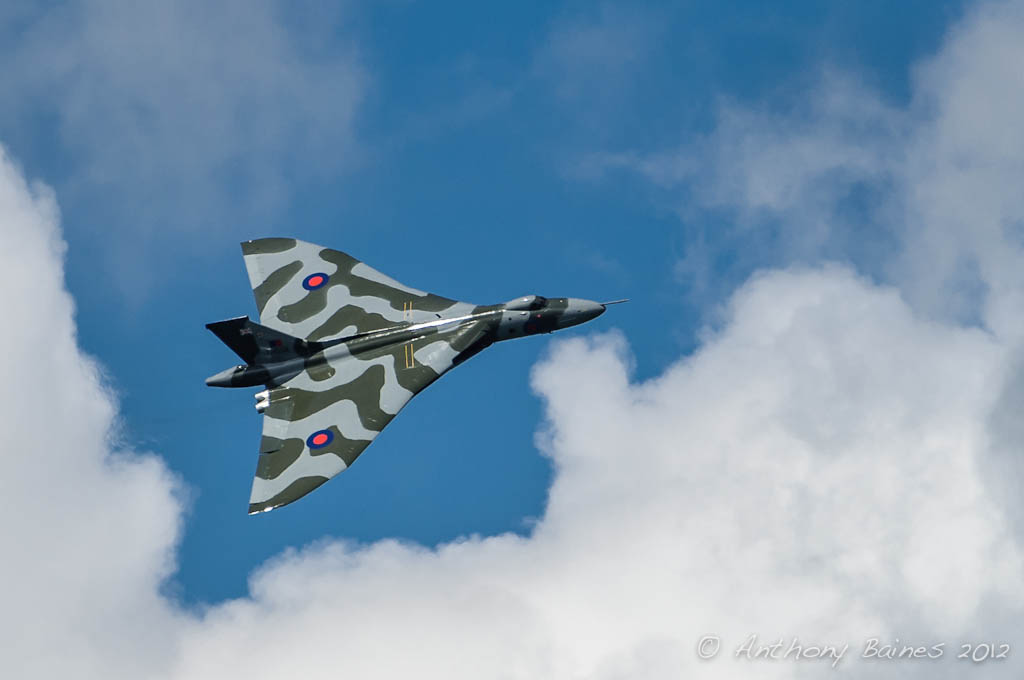
As a contrast to the previous picture: blue sky greeted the Vulcan
Likewise, the RAF Display Tucano got plenty of the blue stuff
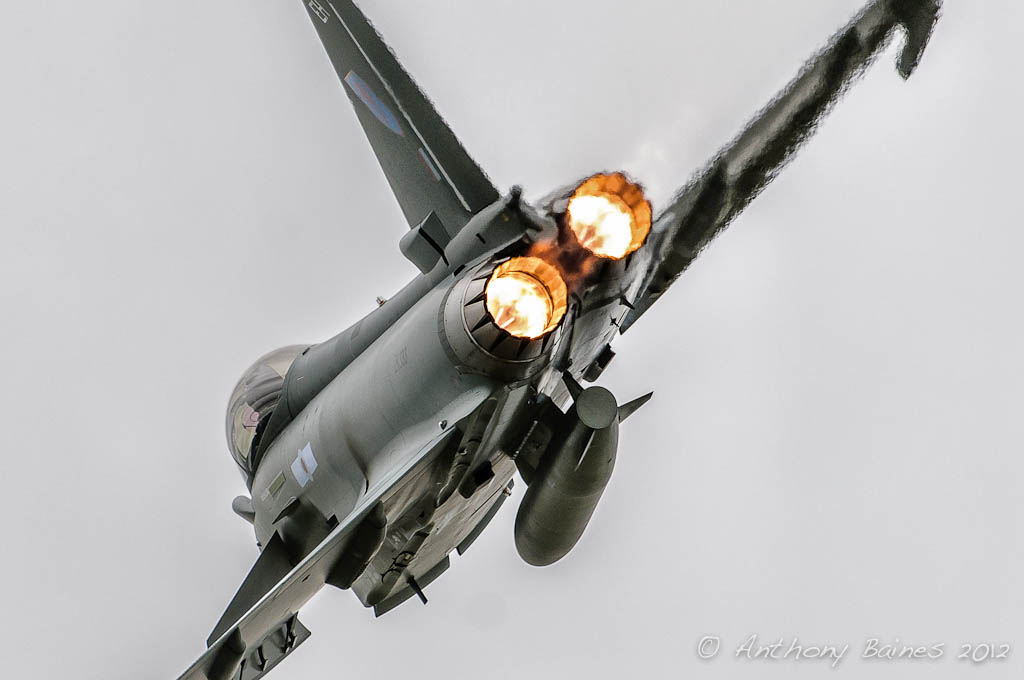
But the grey gloom returned for the Typhoon

It was one of those days when I was quite happy to leave a little earlier than I might have, just to avoid the worst of the mud. RIAT is always a great show every year, but this is now twice in just a few years when the weather has really let us down. In 2008 the weather was so awful and the car parks were reduced to impassable mud that the whole show was cancelled. Nevertheless, three days of enjoyable displays, and types I would never otherwise see.

Roll on next year!

The busy aviation photography week: Part 2 Headcorn


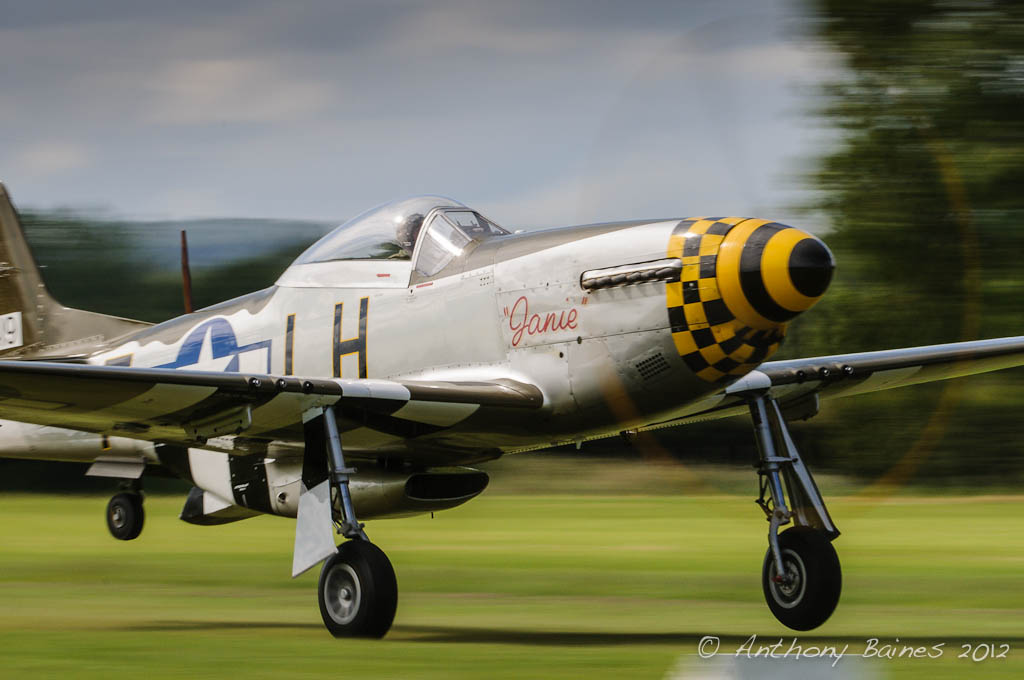
Janie taking off. By no means a technically perfect shot: see discussion below. Nikon D300 with 200-400 AFS VRII lens, 1/80 sec, 200mm, panning on the Wimberley.

RIAT is such a big event that I like to use the best possible lens for it: to catch a fast jet on a low pass, for instance, is very demanding on the lens/camera combination. For my taste, the best airshow lens of all is the Nikon 200-400 mm F/4 AF-S VRII. It is very fast focusing, its F/4 aperture has plenty of light grasp and it is just plain sharp throughout the range. So, I've taken to renting it for the period. I picked it up in advance of RIAT from my rental agency and took it along to Headcorn for a bit of practice. Martin had very kindly lent me his Wimberley head for the tripod: I wanted to try panning the lens with slow shutter speeds, for take-offs and landings.

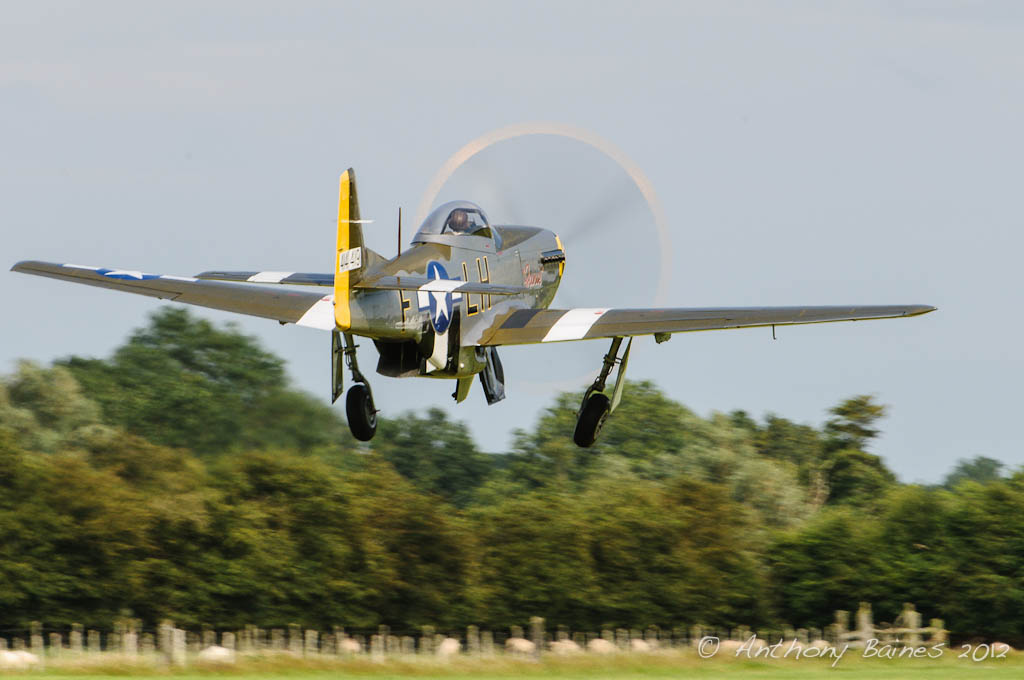
I was just setting up the lens and Wimberley when I was approached by the local airfield photographer, Richard. He said to me "Are you here for the Mustang?" Of course, I'd not heard about any Mustang and I was delighted when he said that Rob Davies has P51D Janie at the moment; Janie would be coming through on the fast pass followed by landing to drop off a passenger.

Janie duly appeared in the sky and dived on to the field making the distinctive Mustang whistle as she came. Rob did his classic very fast and very low pass straight through the field: fabulous!

The delighted passenger

Janie taxiing for departure


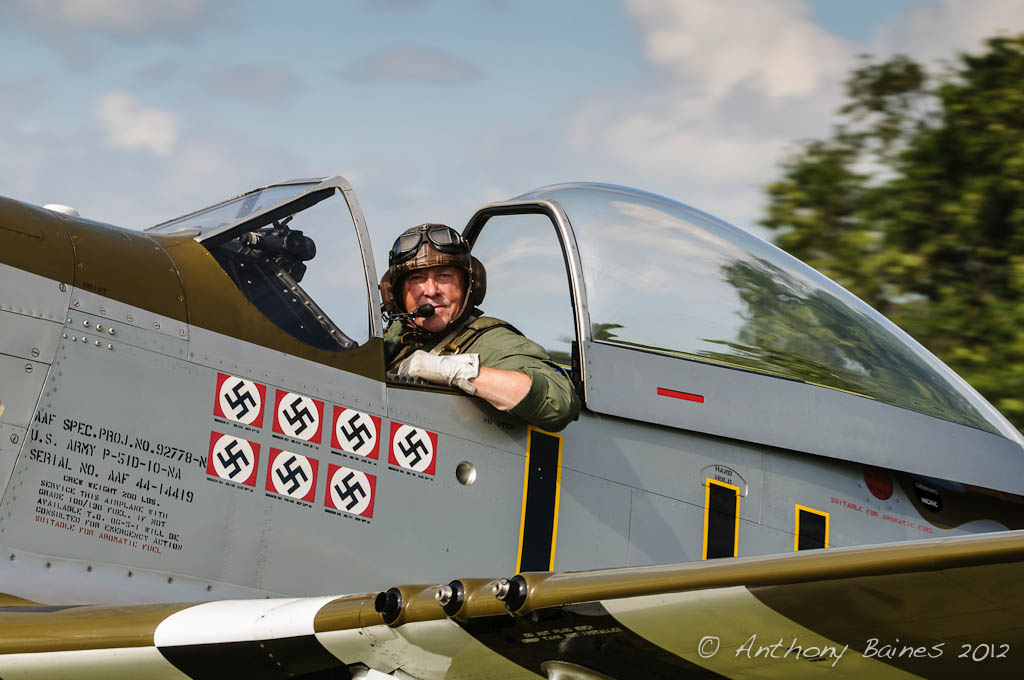
Mustang pilot
Anyhow, as they came into land I caught some shots, again as the delighted passenger left the plane, and I caught a portrait of Rob as he came past me that I think it looks great.

I took a load of pictures of other aircraft that afternoon which I won't put up here. The net result though is that I think the Wimberly is just fantastic for panning with aircraft as they take off and land. I found that I could get sharp pictures at 1/60 at 400 mm. 

The big problem, though, is that the grass track at Headcorn makes the aircraft bump up and down while they move. What is obvious in the opening picture at the top of this post is that while the parts that are sharp are very sharp, there is movement both front and back in the vertical direction that gives some blurring to the image. The picture is therefore not technically perfect; nevertheless, I quite like the effect as I think it further conveys, along with the blurred background, an impression of speed and movement in the image.

Mustang departure

The busy aviation photography week: Part 1 Flying Legends


This is the time of year I try to take some time off work to indulge myself with a week of aviation photography. The two big shows of the year that I like to go to – FlyingLegends at Duxford and the Royal International Air Tattoo at Fairford - were scheduled this year for successive weekends (3June/1 July; 7/8 July). Arrivals and practise at Fairford are a great opportunity to see visitors arriving: many overseas airforces send representatives, very often in novel and garish paint schemes, that add to the interest, so I like to spend some time before the main show at Fairford watching them. This year, I also popped into Headcorn, a local airfield I’ve blogged about previously, between the two shows for some pre-RIAT practise. I’ve put up sets of pictures from each of these on Flickr[i] as follows:

These won’t be reviews of the shows – others such as UKAR will do that anyway – but rather more of a photographic diary. It has taken me quite some time to get round to writing these up: life just gets in the way.

Flying Legends 2012

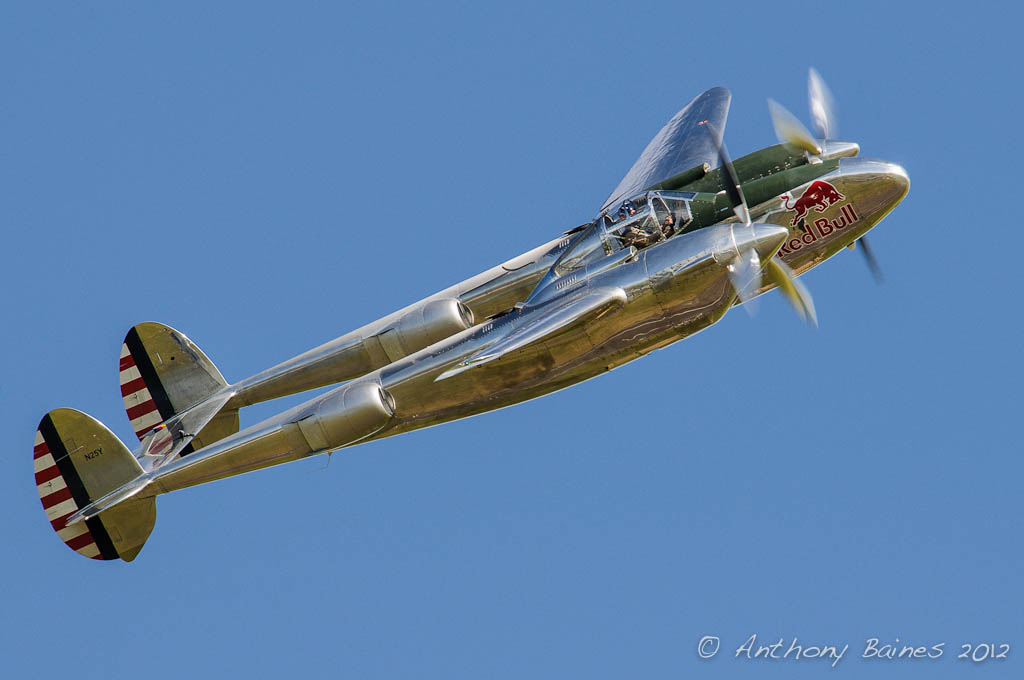
Flying Bulls P38
 Flying Legends is always fun: there’s a huge variety of vintage aircraft, with many rare/unique warbirds taking part. They try to keep the flying display high tempo with multiple aircraft in the air at once, with tail-chases, mock dogfights and the rest.

The morning can be spent on the flightline, looking at the aircraft on the ground reasonably close up. Large numbers of re-enactors also turn up, posing as pilots, nurses and anything else that is of more-or-less a period nature. Usually I try to ignore them (they get in the way of the planes!), but this year I had a go at photographing them as well. They’re really cooperative, which makes it a bit easier. Re-enactors are a very interesting phenomenon: it is all about nostalgia and “remembrance of times lost”; I’m sure someone must have written their sociology PhD thesis on it.

Guarding the Lysander
 The conditioned reflex that most of us have is to instantly turn pictures of re-enactors into sepia tones (like this). For fun, I tried to do one a little differently, giving it a faded and discoloured look, as well as adding some scratches and imperfections. (Another sociological oddity: spend a huge amount of taxed income on the best cameras and lenses, and then make the pictures look like crap!)  I’d found On One Software’s PerfectEffects Free  a few weeks ago, and hadn’t really given it a run out.  In this picture, I used several different effects from that package applied selectively via PS layer masks, as well as blending in the original colour image on a soft light layer. Just playing, really, but I quite like the effect.

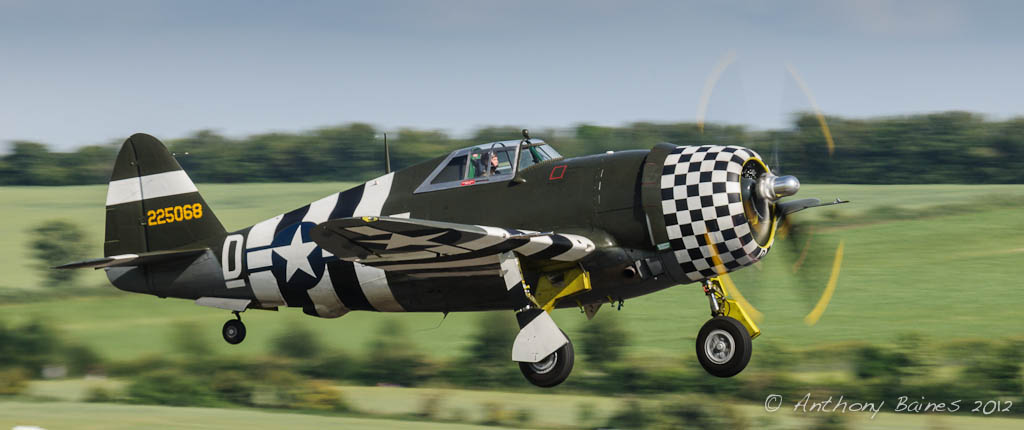
Snafu
 There were some wonderful aircraft at Legends this year. Others can do a full review, but among the highlights were three Mk I Spitfires, the Flying Bulls P38 (opening picture; the P38 is one of my all time favourite aircraft), and a newly restored P47G “Snafu”. Snafu is of particular interest to me, because it represents the “razorback” form of the P47, a type that flew from the ALG at High Halden[ii], just up the road from where I live. The P47s that flew from there were P47D types; the P47G is essentially the same, just built by Curtis-Wright, rather than Republic.

Osa's Ark
 One other welcome participant at Flying Legends was Osa’s Ark, the Sikorsky S38 I encountered in Belgium last year. She was over with owner Tom Schrade and his partner, who were attracting a huge amount of interest from people on the flightline walk. 

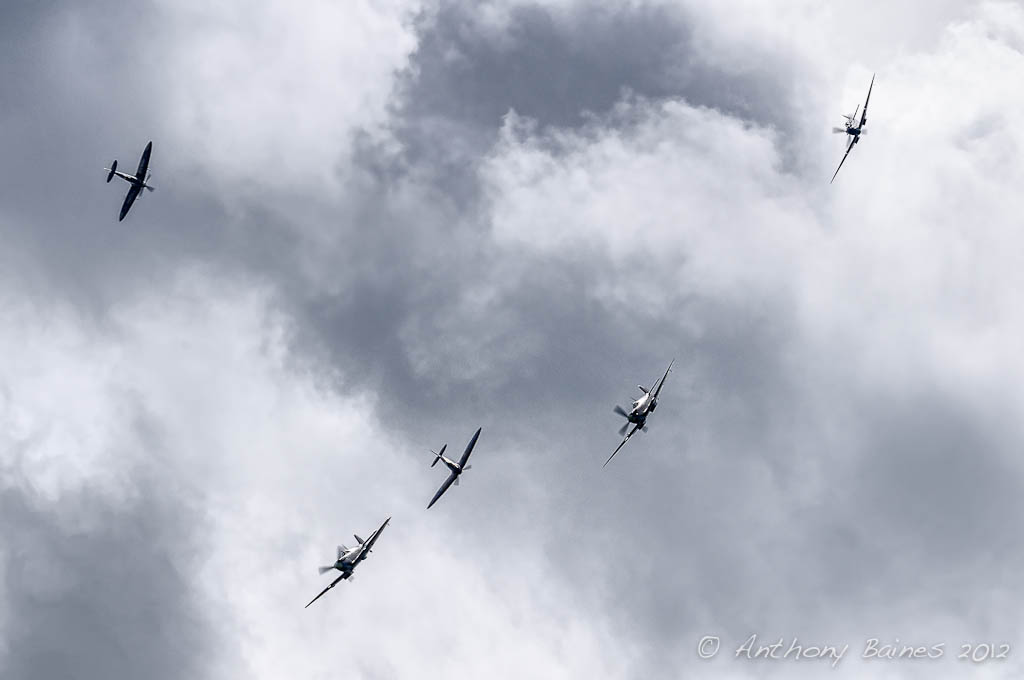
Spifire sky

 Fortunately, there was some blue sky while the flying programme was on. We’re in a run of cold, wet, grey weather at the moment, and I’d been worried that it would rain all day, but the weather gods relented for that afternoon.

Balbo finale
The show ended, as always with a Balbo of  as many of the aircraft as they can get into a single stream: the picture shows 21 aircraft in the assembly. A wonderful sight, not to mention sound.

An excellent afternoon’s flying in the company of Graham (Flickr:nacl1) and Yvonne.


[i] I’m now running – temporarily at least – two parallel photosharing sites. For years, now, I’ve been using Pbase as my photo-sharing site: www.pbase.com/anthony. Now I'm using Flickr as well: http://www.flickr.com/photos/62283880@N04/. Two things have changed. The major one is Lightroom. Lightroom is central to my imaging workflow: among its features is direct publishing to the web. Flickr has an excellent publish-from-Lightroom facility. Unfortunately, Pbase has no equivalent, and despite long-standing requests on their forum, there’s no sign of any progress. Uploading to Pbase is not hard, but it does take more clicks to do it.  The other point, of course, is that photosharing is social: Phil and Martin are on Flickr, not to mention many other photographers I know, so it makes sense for me to be there too. What to do longer term? Not sure: I’ve built up an extensive archive on Pbase, which many of my friends know about, but now I’m getting contacts via Flickr. Oh well….


[ii] If you are interested in the Advanced Landing Grounds and their history, I recommend strongly “Thunderbolts over High Halden” by Graham J Hukins. This book was self-published in 1996, and I came across it in a bookshop in Tenterden about that time.  I’ve no idea whether it is still available, and a Google search doesn’t reveal much. Well worth trying to find, though.

Friday, 29 June 2012

Heath Spotted at Hothfield Heathlands

As a kid it was always Hothfield Common but it's got a smart new name now and is very well managed by the KWT.

I'd been over a few times during the winter to do some landscape photography and was drawn there again by reports of over 1,000 Southern Marsh Orchids on the reserve. I arrived just before 6am and located them shortly afterwards, but there was a problem. The orchids were growing in a marshy area that was a few inches deep in water with even more inches of mud. Furthermore, the resident highland cattle appeared to frequent this area so there was the cow dung to contend with too. I had my walking boots on but it was going to be a 'wellie' job for sure.

I made my way across to the main bog and as I approached, I could see it was covered in Bog Cotton. On getting closer I could make out what I thought were Common Spotted Orchids but on closer inspection, turned out to be Heath Spotted. This was a real bonus as there were thousands of them with many being easily accessible. I spent about an hour photographing them before the wind got so strong as to make things impossible.

Heath spotted orchid flower spike
A trio taken from above
Close-up showing the beautiful flower detail

Back in my wellies


I returned that evening with the appropriate footwear to photograph the Southern Marsh Orchids. I could not lie or sit down so had to squat precariously, ankle-deep in slurry. Focusing was very difficult, even with live view, to the extent that I only managed a few record shots.


Southern Marsh Orchid flower spike
Although rarer than the Heath Spotted, they are not as photogenic, exacerbated by the fact that most of them had 'gone over', with brown tinges appearing on the lower petals.

Wednesday, 20 June 2012

A morning on the Kent Downs

We were blessed with a beautiful day yesterday and I got up early to make my way over towards some local orchid sites. First on my list was late spider (having missed early spider earlier in the year as I was away when they flowered).

I spent about an hour photographing a single specimen. This is the best of the bunch.


Later in the morning the wind got up, making macro work very difficult. Here's a common fragrant with a supporting cast of buttercups and others.


There were a few pyramidal in a sheltered position and I grabbed a few shots of these too.


Monday, 18 June 2012

Bringing home the RPS bacon


With Anthony recently being successful at Associate level with the Royal Photographic Society (RPS) there was a certain peer pressure for me and Philip to tread those same steps. We decided to submit a panel for the Licentiate distinction first, despite the fact that one can go straight for ARPS if so inclined (brave and foolhardy some might say).

Preparation


The most common method of attaining an LRPS is to submit a panel of 10 prints. It is possible to provide a set of digital images for projection but the pass rate is known to be lower and, as Philip and I are happy working in print media, it was a 'no-brainer'.

I started thinking about my panel seriously early this year and quickly settled on a theme with a three-row layout: a top row of nature, a mixed middle row and a bottom row of monochrome landscape. Philip and I each put a draft panel together, along with a few spares, and took it along to an RPS Advisory Day - luckily there was one nearby in Canterbury in mid-April. The day was led by Richard Walton FRPS and he gave each of us sound advice on our panels - in my case totally restructuring it by removing all the landscapes, changing from three rows to two and making the top row nature with a mixed lower row. It appeared to hang together well and I stayed with Richard's suggestions and re-printed and re-mounted accordingly.

Note: If you thinking of submitting a panel for assessment, attending an advisory day in advance is a MUST. You get to see examples of successful panels and get expert advice on your work from an RPS Fellow.

Assessment (judgement) day


Our chosen assessment day was last Thursday, 14th June, and we headed off to Bath the day before so that we could hand our precious cargo in the day before and spend some time taking some photographs around the City. I have some friends who live just outside Bath and they were kind enough to put us up for the night in exchange for a meal at At The Chapel in Bruton. Sue kindly offered to drive and we had a fantastic evening. A combination of a fatigue from traipsing around Bath and a few local ciders meant that we both slept really well the night before.

We headed off to Bath, parked up near to RPS HQ and found a delightful Italian deli for breakfast. On entering Fenton House we mingled with other equally anxious souls in the foyer before being invited upstairs to the assessment room.

We were sitting right at the back (~20m) from the prints so could not see them in great detail, awaiting eagerly for the panels to be hung. The chairman of the assessment panel introduced himself, gave an overview of proceedings, after which the other five assessors introduced themselves.

There were two digital entries which would be screened first, followed by the prints (about 30 I believe). The individual images are scrutinised and the overall panel is considered, after which the assessors form a huddle and fill in their score cards. Everyone holds their breath awaiting the outcome. One of the assessors talks about the panel highlighting its positive and negative merits before issuing their judgement, which takes the form of 'we are unable to recommend this panel' or 'is <author's name> in the audience'.

Well, the first two projected panels failed on technical reasons. No surprises there really. Then the first print panel went up. From the back of the room it looked to be a good one, made up of a set of interesting and well balanced prints. Then we heard those words again....'we are sorry but we are unable to ...........'

The next print panel came up and that failed - as did the next three. That made it zero acceptances out of the first six - ouch! You can imagine how we were feeling. Finally though, a successful panel. A huge sense of elation from the photographer and a slight drop of tension in the room. The next panel then failed! After that the pass rate was higher and, by the time we left at lunchtime the balance was around 50:50.

My panel came up around noon and I waited in anticipation for a couple of minutes (that felt like a couple of hours) before the assessor praised my panel and finished with those words 'is Martin in the audience' - deep joy and much shaking of hands.

We knew that there would be a break for lunch at 1pm and I could sense that Philip was getting more and more tense as time went on. It suddenly dawned on me that if Philip were to not make the grade we would have a thoroughly miserable journey back to Kent - he in despair and me racked with guilt.

At 12:50 Philips panel was displayed. I have to say, from the back of the room, it looked good. I was confident and I smiled at Philip who could not reciprocate. So many panels were failing on technical issues: not sharp, over-sharpened, colour casts, lack of highlight detail and poor print quality being the main reasons.

The assessor who spoke on Philip's panel enthused over it commenting along the lines of 'here is someone who's photography is in the same style as mine but who does it better'. A well deserved pass!

When we went to collect our panel we were asked by the RPS if they could hold on to our panel and use them as examples for use in forthcoming advisory days. We were flattered and left even more contented with our print boxes empty.

There had been one more panel before lunch (a quick celebratory drink and a panini) after which we decided we would depart gracefully and try and beat the traffic.

Our panels


Special thanks to


Philip for sharing the journey, including that last-minute sizing, printing and mounting.
Anthony for giving us the confidence and moral support
Ashford Photographic Society for providing a rich environment for us to develop our passion for photography
My wife Julia for putting up with my moods over the last few weeks

Friday, 8 June 2012

Simple intensification of blue skies in Camera Raw or Lightroom

Fig. 1. Belgian Air Force F16 displaying at Duxford, May 2012. (Left) Straight from the camera. (Right) Blue sky intensified as described in the text.
I'm sure this idea has occurred to many other people, but I've not seen it in any online tutorial specifically, so I thought I would post it.

When I'm photographing aircraft against blue skies, I like the blue to be really intense blue, a bit like the sky in high mountains (or, more prosaically, the effect given by a polarising filter). British skies are usually some pallid shade of blue (Fig. 1, left) rather than the intense blue I like (Fig. 1, right). So, for the last couple of years, I've been using a very simple way in Camera Raw and now Lightroom to intensify them. There are lots of other ways to do this, but this has the virtue of being simple and quick.

The blue of the sky sits conveniently within the colour range covered by the Blue slider in the HSL panel. The sky can be darkened simply by sliding the Luminance Blue slider to the left. Sometimes skies can have a bit of Aqua in as well, so that slider might have come down as well. The best way to do this is to use the targeted adjustment tool for Luminance and then drag downwards on the sky.

What usually happens when doing this, though, is that the apparent saturation of the sky increases to the point where it is not realistic. So now use the targeted adjustment tool to drag the Saturation on the sky down (maybe just a little) to the point where you get a fairly realistic looking intense sky.

At this point, all the manipulation to the sky can bring out a lot of noise. So it is necessary to add a bit of noise reduction from the Detail panel. It may be necessary to use both Luminance and Colour noise reduction.

For simplicity, I've set up a Lightroom preset that drops Blue and Aqua Luminance and Saturation and adds some noise reduction. This makes a good starting point for intensified skies, and typically does not require big moves on the sliders from there to get a satisfactory result. Fig. 2 shows the HSL settings for this.

Fig. 2. HSL settings for simple blue sky preset (Lightroom 4.1)
This works well so long as the subject aircraft is not bright blue itself -- and most that I come across are not. Even where an aircraft has, say, a blue stripe on it, the effect is not objectionable, and so generally does not require masking off.

Friday, 1 June 2012

Focus stacking wild orchids

Monkey orchid flower head: D300/ 90mm Tamron f/2.8. Focus stacked with Helicon Focus.
Orchids in the landscape. D300/Sigma 10-20mm f/4-5.6
As a follow-up to Martin's last post on photographing wild orchids, here are a couple of mine from this week.

The evening when Martin and I went to see the orchids was very still, so it looked like a good time to photograph them: even though the light was quite dim, the orchids were not moving in any wind, so slow exposures were possible. The sky was also quite bright, which gave the opportunity to open up the shadows in the orchid flowers by using a small reflector positioned at the base of the orchid plant.

I wanted to be able to get some close-up pictures of the flowers where the background was suppressed by being defocussed. The problem with this is that the orchids were in quite dense foliage, so to get an out of focus background means using quite a wide aperture. Correspondingly, there is then the problem of depth of field across the flower. As I have blogged previously, one solution to this problem is to use focus stacking. In this, a series of images is taken by changing the focus point through the subject, and then the images are combined in software (I use Helicon Focus) to produce a sharply focused image across the depth of the subject. The background is still so far out of the plane of focus that stacking does not change its smoothness.

We met Martin's friend Steve at the site, who was also out photographing the orchids. He is another Nikon user, and he offered to lend me his Tamron 90 mm f/2.8 macro lens to use on my D300. The picture at the opening of this blog post (upper picture) is a stack from one of the resulting series of images with his lens (thanks, Steve!). The images were all taken at f/5.6, which I chose to give a sufficiently smooth background, but with enough depth of field within the flower so that the individual planes of focus did not have to be impossibly close to each other. I set the camera onto manual control (aperture, shutter speed and focus), and then used the smallest possible movements of the focusing ring between shots to move the plane of focus across the subject.

Back home, I simply exported 16-bit ProPhoto RGB Tiffs from Lightroom, and popped them into Helicon.  As a first go at focus stacking orchids in the wild, I think it is not too shabby, and the Tamron lens seemed to live up to its very high reputation.

I had taken my own 60 mm micro-Nikkor: although that is a great studio-type lens for flowers, on this occasion I really feel that the extra focal length of the 90 mm was very helpful. It would also have been nice to be able to control the camera using automation to ensure even and small steps. Helicon Remote does this very well, but you need to run it from a laptop, and I have enough to carry without schlepping a laptop on countryside shoots! I see on their forums that Helicon are finding it difficult to adapt Helicon Remote to the iPad: I hope this can be sorted because I think that controlling focus stacking from an iPad in the field would be a very powerful approach.

I went back with Gina a couple of days later. She was also keen to see the orchids, and was an uncomplaining assistant with another shot. The evening we went back it was too breezy for focus stacking -- the orchids were waving around far too much. But the overall light was nicer, so I tried some pictures to show the orchids in their landscape setting (lower image, above).

My idea was to try to show the orchids (really quite small flowers) and the slope of the valley they are growing in. As I've mentioned previously, I have a predilection for using an ultrawide lens; I thought that by getting down to the level of the flowers, and as close to them as possible, with the Sigma 10-20mm lens set at 10 mm on the D300, it should be possible to show them in their context.

Several difficulties came up with this, not the least being that while the lens needed to be set on very close focus for the orchids, but I also wanted to show the extent of the valley. The simplest way to get the required depth of field was to use f/22. If you read the forums, you will be told in no uncertain terms never to stop down this far because diffraction effects will ruin the picture. And there is no question that this setting does nothing for the ultimate sharpness of the image. In general terms, it might have been possible to use focus stacking to achieve the extreme depth of field I wanted, but with the flowers waving in the wind I didn't fancy effects of ghosting. The other problem was with the range of brightness between the side of the valley where the flowers were and the sky that I wanted to include. The brightness range was in excess of four stops. So to get everything on scale with a correct exposure overall in a single image, I put a three stop graduated neutral density filter over the sky (which also impinges on the tree line), and then lit the foreground by firing in a flash through a large diffuser. The flash helped give the orchid colours a bit of pop. I am reasonably happy with the resulting image: it required minimal post processing, and just for tidying up. I suppose I could have HDR’d it, or blended several exposures by hand in Photoshop, but I’d actually prefer not to.

Thinking about it, I think these two pictures illustrate the way I prefer to work. I’ll assemble a picture in post-processing when I need to (there’s no better way to get the first picture than by focus stacking), but I enjoy the challenge of getting a picture in a single raw file if I possibly can, even if it means using a combination of ultrawide lens, tripod, remote release, flash and wireless trigger, diffuser and ND grad. Nothing’s simple!

Lots of fun, and thanks to Martin for getting us there in the first place.

Tuesday, 29 May 2012

Photographing wild orchids

Introduction

It's all too easy to be lulled into thinking that you have to travel the earth got get interesting photographs. For me, one of the joys of photography is that there vast array of subject matter on my doorstep. All one needs is a bit of imagination and a sense of adventure.

For instance, Anthony and I were on the North Downs in Kent yesterday evening photographing monkey orchid. As well as proving interesting subjects, the peace and tranquillity in the countryside at that time of day proved a real tonic after a hectic day at work. 

In contrast to this, we will be at the Folkestone Air Show on Saturday, with as much noise and raw power that one could want. Totally disparate subjects and environments with entirely different photographic techniques required - a challenge that we both enjoy!

My nature photography journey

I've been interested in nature from a very young age, with a particular fascination for birds. Seasonal, gender and age variation together with migration meaning that there's always something interesting around at any time of the year. I have been photographing birds seriously for about eight years now and last year I diversified and developed a passion for wild orchids. Living in Kent gives me lots of opportunities to capture images of these as there are a number of excellent sites in the county.

My bird photography is characterised by paying very careful attention to the background (diffuse but complementary) as well as rendering the main subject sharp, and my approach to photographing orchids follows the same principles. The advantage with orchids is that they don't fly away; the disadvantage is that they are static and can't 'pose' for you. So it's all about lighting and composition.

I very much like to photography butterflies but numbers are very low this year, I guess in part due to the very wet April.


My approach to photographing orchids


Everyone has their own approach and there's no right or wrong way; that said, some work better than others. Here's a quick check-list:

  • Do some research to estimate the best time of year to go for your target species. Some will only be in flower for a couple of weeks and this period will vary from year to year depending on how warm/wet the spring has been
  • Keep an eye on the weather forecast and plan your trip for when there will be light winds - ideally less than 5mph - you may think the flower head is not moving but it's the biggest factor leading to blurred images
  • Avoid bright sunny days as there is likely to be too much contrast to capture the subtlety of the flowers effectively
    • For the two previous reasons I prefer the hour after sunrise and the hour before sunset to maximise my chances
  • Equipment wise, an SLR/macro lens combination is preferred. However, any lens with a focal length above 200mm can give good results. A tripod and/or a large beanbag is a must, as is a reflector to push light under your subject when doing close-up shots (don't underestimate the value of these simple props)
  • Technically, I use mirror-lock-up in combination with a 2-second timer delay (although many people prefer using cable release)
  • I shoot in aperture priority mode, with apertures ranging from f/4 for the whole flower to f/16 for close-ups
  • It's then a case of composition and execution - carefully checking exposure, focusing and keeping those backgrounds nice and uncluttered!
  • Start wide and work in close - see the examples and comments below
Monkey orchid in their natural environment. Early morning dew still heavy on the vegetation. Note the different shapes and heights. For single flower and close-ups pick a good specimen!


Single flower in its environment. This was taken in direct sunlight - note the high-contrast effect which  is a bit heavy for my taste
Getting in a bit closer now and depth-of-field is much narrower. I like this representation as it focuses the eye on the orchid flower and stem, with a subtle, complementary background melting away
Just the 'flower spike' lots of detail becoming apparent now, with the individual 'monkeys' clearly recognisable. The background is complete mush but a very natural colour!
A single 'monkey'. You really need a macro lens to get in this close.
If you have never photographed wild orchids before I'd recommend you give it a try. You won't get it right first time but you'll start on a journey that is not only fun but it will seriously hone your photographic skills


Friday, 18 May 2012

La Corrèze #3

The Eyrignac Manor Gardens

The gardens are to the West of La Corrèze, actually in the Dordogne region.

When we had been in the area previously we had decided to visit Eyrignac Manor Gardens which lie near the town of Sarlat. The gardens are unusual in that there are very few flowers, with the emphasis being on structure, form and texture.

After a drive of around 1h40, we arrived just in time for lunch (never a bad thing in France) and promptly found a table in the restaurant and enjoyed a salad before strolling round. The photos don't need much explanation so I'll let them speak for themselves.